

Ukraine’s bombing of strategic Russian oil town of Tuapse prompted Kremlin oligarch to call for “trinitrotoluene”, or nuclear-armed response.
 Roman Pataj



Every day, the Ukraine Battlefield update newsletter offers a clear look at how the war is unfolding on the ground, highlighting key developments along the frontline and the shifting dynamics of the conflict.
On the strategic importance of Tuapse and the furious Russian reaction to its destruction. Konstantin Malofeyev is a Russian oligarch, media magnate, radical believer, ultra‑nationalist, and Russian imperialist. His money was behind the start of the war in the Ukrainian region of Donbas in 2014, and he also influenced malign events in Slovakia (here and here). His personal Telegram account is followed by almost 1.4 million people. And on Wednesday (29 April), he published a post, which was shared by another pro‑war Russian – frontline reporter Roman Saponkov.
Their point was clear, even if not explicitly stated – in response to the attacks on Tuapse, Russia should strike Ukraine with nuclear weapons.
“It is time to protect our cities from fires and oil leaks not with self‑sacrificing volunteers, but with missile forces. With an honest, open notification to the inhabitants of western Ukraine 72 hours in advance: this is the area, this is the time, these are the consequences, these are the evacuation corridors. And if the enemy still has forces and will left, then the power in trinitrotoluene equivalent will be further increased. Only in this way, and no other, can our cities and our people really be protected so that there is no new Tuapse in a week’s time,” said Malofeyev.
The nuclear threat was hidden in the words “power in trinitrotoluene equivalent”. This is how the yield of atomic bombs is measured. This was not an isolated call for their use; events in Tuapse unusually irritated Russia.
And the explanation is only partly economic. To a large extent it is military. The lamentations over an environmental disaster are merely hypocritical, because Russia has been committing the same on Ukraine for four years, and no one in Russia has been troubled by it.
“Third air raid in two weeks. The refinery is on fire again,” the Russian Telegram Z‑channel Notes of a Veteran wrote. It explained at length what the problem was for the army. There have so far been three raids – on 16, 20, and 28 April. The author claimed that the first strike hit “key technological equipment” and the refinery “practically stopped operations” after it. On Tuesday morning, he added that “today’s attack is probably meant to finish what was started”.
“New day – new strikes,” another Russian source – Archangel Spetsnaza – began his message on Wednesday before noon. It was a reaction to the bombing of oil infrastructure in Perm. The same city and its pipelines were successfully attacked by drones again on Wednesday night into Thursday.
Local residents in Perm, surrounded by fires from Ukrainian strikes on oil infrastructure, are assessing the aftermath of today’s attack on the AVT-4 unit at the Lukoil-Permnefteorgsintez refinery. https://t.co/i00qxhQN12 pic.twitter.com/bg73HBlXHf
— Special Kherson Cat 🐈🇺🇦 (@bayraktar_1love) April 30, 2026
“This is further proof that distance has long ceased to be a guarantee of safety. Reinforcement of defences is required everywhere Ukrainian unmanned aircraft can reach,” the author wrote, but he was demanding something completely unrealistic, because Russian air defence has no chance of protecting the entire territory of Russia.
This also follows from a map by French analyst Clément Molin, who compiled an overview of 450 successful attacks on the Russian rear in April. Most of them are within about 100 km of the frontline, but more and more are going much deeper.
This month of April alone, Ukraine 🇺🇦 launched 450 (!) successful strikes on Russia 🇷🇺 and occupied territories.
Among those are part of the nearly 600 mid-range strikes with FP-1 and FP-2 drones into occupied territories since the year started.
🧵THREAD🧵1/7 ⬇️ pic.twitter.com/3OPpesMvNB
— Clément Molin (@clement_molin) April 29, 2026
Polish military analyst Maciej Korowaj pointed to the economic consequences of the attacks on Tuapse. According to him, Tuapse “is not just any refinery”, but one of the five most important hubs in all of Russia.
Tuapse itself accounts for processing four to five percent of Russian oil, but because it is a terminal point of the system, disabling it triggers a cascade of events that can reduce total production by up to 880,000 barrels of oil a day, which represents around $100m (€85m) a day.
Tuapse has split the Russian opposition – is it an unforgivable environmental disaster or a deserved punishment for aggression? Yes, something like a Russian opposition does exist, but mostly in exile. Its representatives comment on events in Russia from abroad, because if they did so at home, they would end up in prison. Radio Liberty published a long piece on the views of these people and of the inhabitants of Tuapse on the disaster that struck the city.
It is worth reading in full; here we will quote only a few of the most interesting opinions.
The first opinion comes from a co‑author of the nerve agent Novichok. His name is Vil Mirzayanov, he lives in the United States and supports Ukraine. Now, however, he is calling on “the leaders of these countries (Russia and Ukraine) to immediately stop this genocide”. His appeal begins with the sentence that “this criminal war must be stopped immediately”. He claimed that what was under way in Tuapse was a mass poisoning of the population, a large part of which was unprotected and “condemned to a slow but inevitable death”.
The problem lies in the fumes from burning oil and oil products, he said: “As a chemist, I assure you that this smoke is not harmless; it brings death in the form of polyaromatic compounds formed during combustion, including strong carcinogens. The most important thing is that once they enter the body, it is impossible to get rid of them.”
Journalist Tatiana Rybakova, writing for the exile newspaper the Moscow Times, explained that she grew up in Baku and therefore knew well the harmful effects of burning oil. She urged residents to leave the city. “To the officials who are lying about the consequences, I sincerely wish that you experience all this for yourselves,” she wrote.
Environmental expert and conservationist Natalia Novoselova was the most critical of Ukraine: “Ukrainians, defeat the state, Putin’s regime. It is your right. The opposition will support you in this. But do not destroy the environment. With these actions Ukraine has alienated all Russians, including many in the opposition!”
She went even further when she claimed that the attack on Tuapse had caused the biggest environmental disaster in southern Russia, but that attacks on other refineries in Russia had had similar, just less publicised, consequences.
According to Novoselova, Ukrainian strikes on the oil industry are “turning vast parts of the country into a zone of large‑scale environmental disaster”. She described the strategy of the Ukrainian army as ecocide and part of a genocide.
But Konstantin Osin, a refugee from the Russian regime living in Germany, said of such claims that part of the Russian opposition was adopting newspeak.
Instead of the term environmental disaster, he urged these people to use the wording “a retaliatory strike that deprives the fascist state of a significant source of money”.
Alexei Cheremushkin, a persecuted activist who received political asylum in France, also wrote: “Tuapse should have been evacuated a week ago. Yet children are still going to school there. No one knows how many of them will die prematurely … Russians are an undemanding nation. They will even eat strawberries with a heating‑oil flavour”.
He compared the work of the authorities, who were downplaying the consequences, to the Chernobyl disaster: “Chernobyl is in the heads of the Kremlin gods. Along with dementia and the obvious onset of Alzheimer’s disease.”
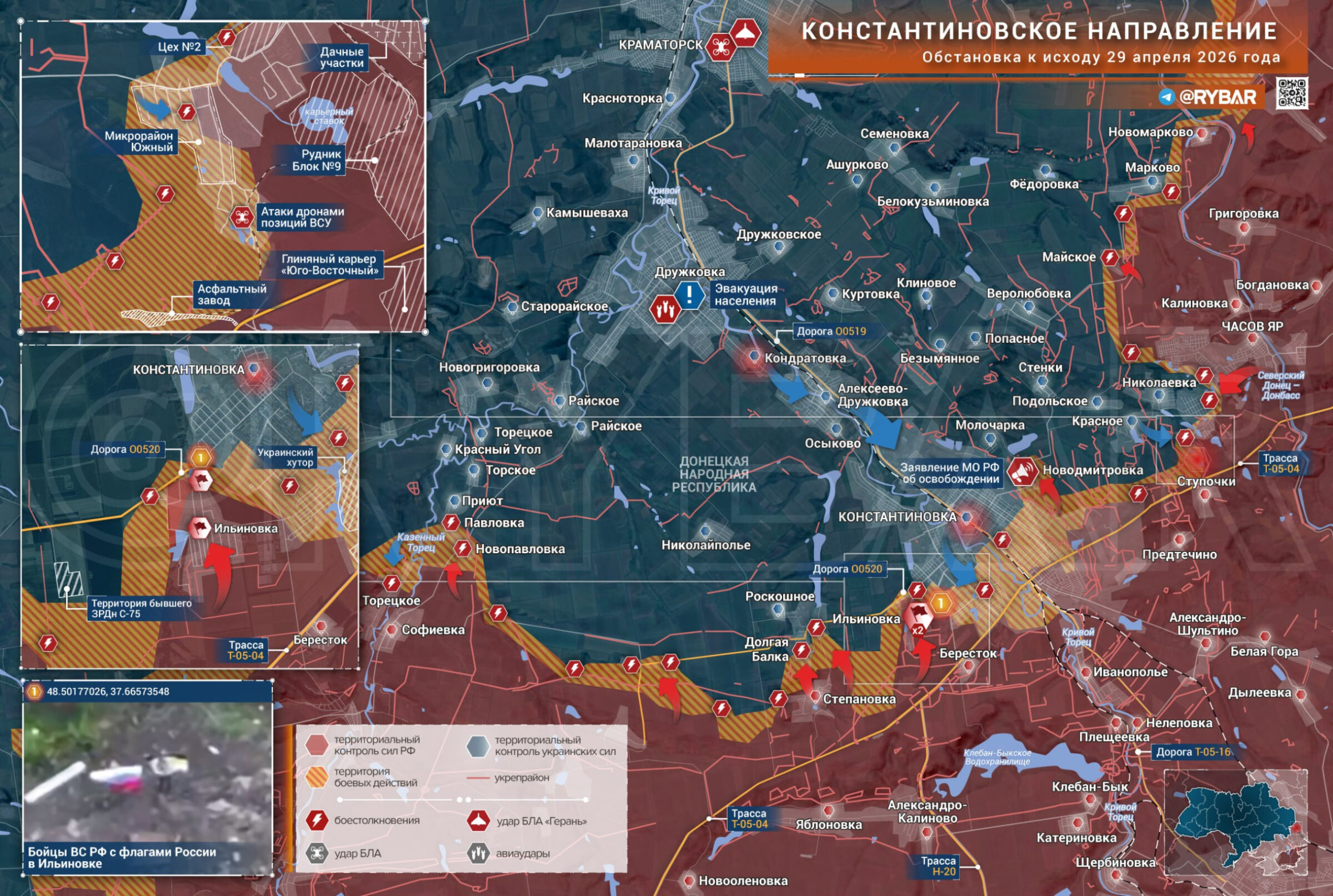
Russians report the capture of Illinivka near Kostyantynivka, with their advance confirmed by Ukrainians. “Konstacha, hell,” is how a Ukrainian soldier writing under the name Bakhmut Demon described the situation in the town in two words.
Konstacha is the familiar name for the bastion of Ukrainian defence in Donbas and the southern “gateway” to Kramatorsk, where the situation is gradually deteriorating. There is consensus on that; the differences lie only in the interpretation of how significant this change is.
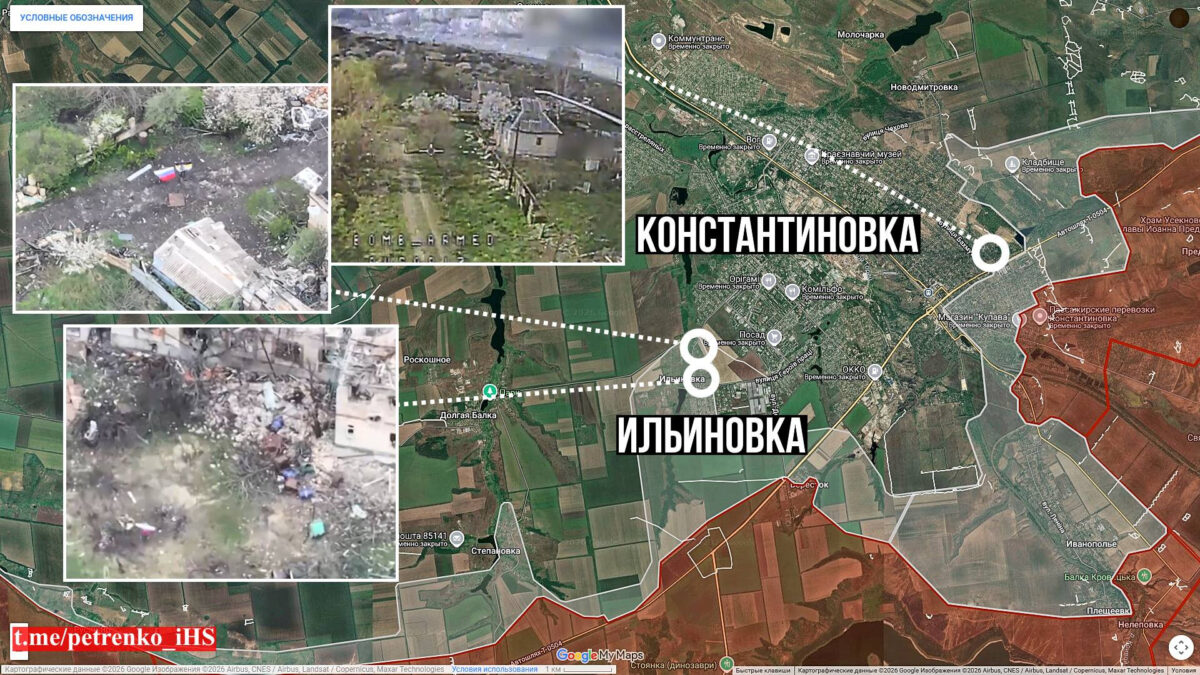
On Wednesday, the Russians announced that they had cleared and captured the village of Illinivka, which covers the town from the west. On their map they marked it with a flag indicating completed occupation. The importance of the village is obvious from the picture at first glance – it is not only a suitable base for penetrating the town from the west, but its capture would allow the Russians to advance further north along its western edge. Beyond that, there are only fields, no inhabited areas.
Another Russian, Yuriy Kotenok, claimed that the Russians had also captured Novodmytrivka on the opposite side of the town.
Ukrainian analyst Petrenko also reported that the Russians had raised their flags in Illinivka, but said that, according to his information, fighting was still under way in the village. He clearly shows Novodmytrivka as being in Ukrainian hands. Over the long term he has been much more credible than Kotenok, who tends to draw Russian positions further forward than they actually are.
Drones hit Russian helicopters 150 km from the frontline. Specifically, one Mi‑17 transport helicopter and one Mi‑28 attack helicopter. The incident took place 150 km from the frontline, and the target was a Russian air force field base.
Both helicopters were definitely operational. A mechanic was just working on the Mi‑17. The drone struck exactly the spot where he was servicing the engine section.
Another soldier ran away after the attack from the hit aircraft, which had a pod of unguided rockets slung under it. Although originally intended as a transport helicopter, both armies also use it for shelling ground targets.
Ground crew were also working on the Mi‑28. One of the soldiers ran away just before the impact.
The attack from the air was recorded by a third drone. In its footage no subsequent fire can be seen, but both aircraft were certainly put out of operation. The drones aimed at their engine sections.
Magyar’s update:
Birds of the USF hunted down and struck two enemy helicopters — a Mi-28 and a Mi-17 — in Russia’s Voronezh region, 150 km from the line of contact.
A field landing strip located more than 150 km deep from the line of contact, hosting four Mi-28 and Mi-17… pic.twitter.com/QlT9LQrD2n
— 414 Magyar’s Birds (@414magyarbirds) April 29, 2026
Videos of the day
Ukrainian drones attacked shelters for ballistic missiles. The Russians claimed that the hardened shelters withstood the strikes and that no damage was caused. Yet the video shows one large fire.
Ukraine 🇺🇦 carried out a strike on a Russian Iskander-M/K missiles site in Crimea
The FP-2 UAVs used were not able to penetrate the reinforced structures. ATACMS, Flamingo, or SCALP-EG missiles would be required to destroy such targets. However, Ukraine lacks long-range missiles pic.twitter.com/K5IcyD5kRv
— Ukraine Battle Map (@ukraine_map) April 28, 2026
The Ukrainian army released a compilation of short clips in which, this time, the sound is more interesting than the image.
Russian accounts commented on this video as proof that Ukrainian soldiers were to blame for Russian drones falling on Ukrainian cities, because they were shooting them down directly from the streets.
The scene indeed looks bizarre, as a soldier with a precision system is firing next to a passing bus, but this is a common phenomenon on the Russian side as well, where air‑defence systems are also deployed in urban areas.
First the Russians captured and destroyed Mariupol, then they indoctrinated its children with love for Russia.
An uneven patch of ground catapulted a motorcyclist straight in front of a Ukrainian drone.
3, 2, 1 — БАМ 💥🔥🚀
Триста і двісті мають бути тільки орки.
Нова порція уражень від «Рарога».
Захисти своє — літай разом з нами!
Приєднуйся https://t.co/QezVyTEYnp pic.twitter.com/W74GgaNgYy
— 427 окрема бригада безпілотних систем РАРОГ (@RAROG427) April 28, 2026
What are the losses
Last updated on Monday (27 April).
By Monday morning, Russia had demonstrably lost 24,487 pieces of heavy equipment (on Tuesday (21 April) it was 24,471). Of these, 19,123 (19,108) pieces were destroyed by Ukrainians, 976 (976) were damaged, 1,206 (1,206) were abandoned by the crew, and 3,182 (3,181) were captured by the Ukrainian army. This includes 4,389 (4,385) tanks, of which 3,292 (3,288) were destroyed in combat.
Ukraine has lost 12,050 (11,977) pieces of equipment, of which 9,272 (9,224) were destroyed, 673 (669) damaged, 671 (670) abandoned and 1,414 (1,414) captured. This includes 1,419 (1,416) tanks, of which 1,084 (1,081) were destroyed in combat.
Note: Neither side regularly reports on its dead or on destroyed equipment. Ukraine publishes daily figures for Russian casualties and destroyed equipment, which cannot be independently verified. In this overview we use data from the Oryx project, which since the start of the war has been compiling a list of equipment losses documented exclusively by photographic evidence.