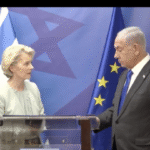

“If the European Union accepts us, we will be happy and enthusiastic about it,” said Armenian prime minister Nikol Pashinyan at a first-ever EU-Armenia summit.
 Andrew Rettman



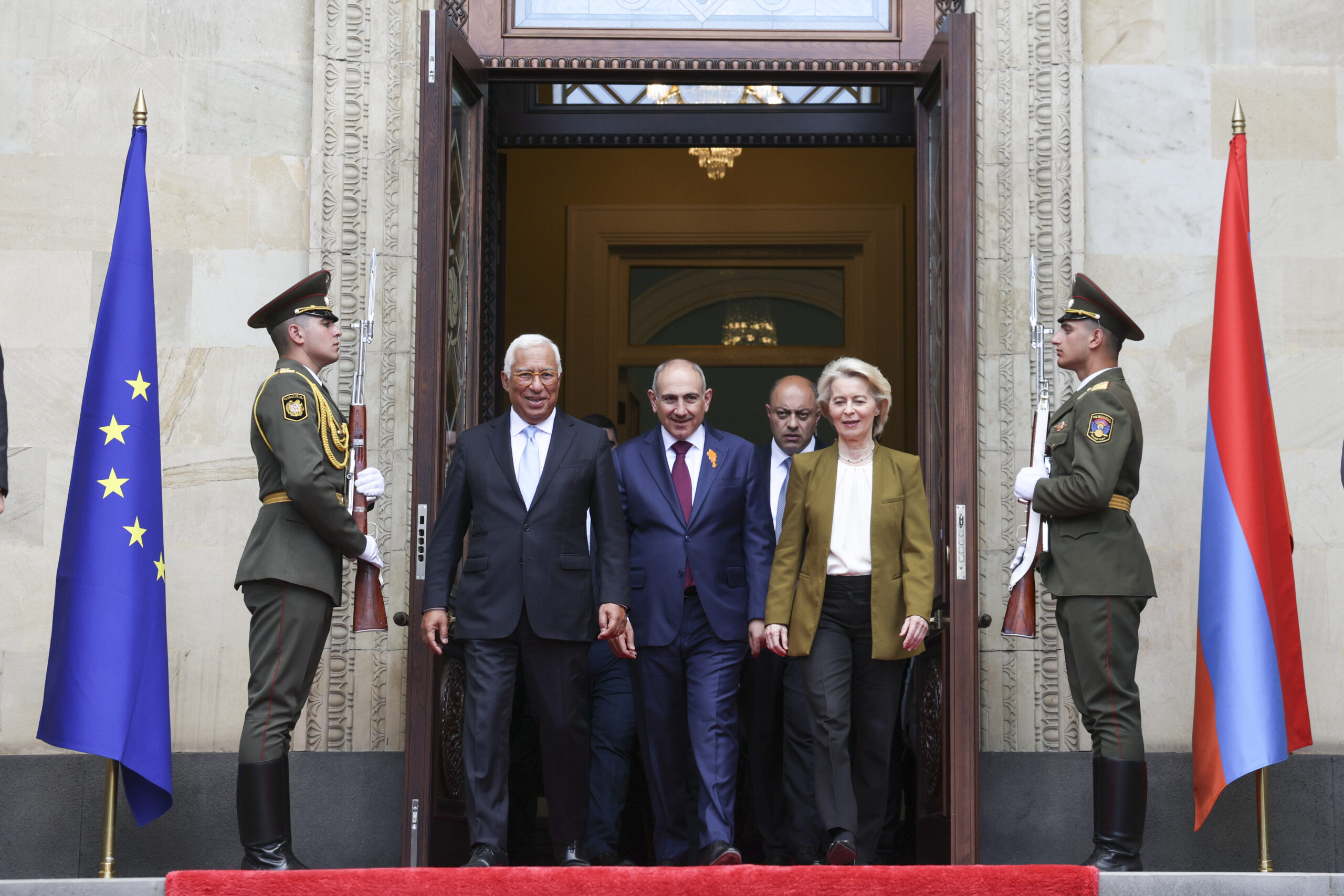
The EU and Armenia have made a show of deepening strategic ties, as Russian and US aggression spur interest in enlargement.
Armenian prime minister Nikol Pashinyan gave the red-carpet treatment, with a military band, to EU Council chairman António Costa and European Commission president Ursula von der Leyen for a first-ever EU-Armenia summit in Yerevan on Tuesday (5 May).
They also signed a six-page declaration celebrating the “historic milestone” in relations and envisaging EU investment in solar energy, transport links, and the AI and digital sectors in Armenia.
“Under the Global Gateway strategy, EU investments in Armenia are expected to reach €2.5bn,” they said.
Tuesday’s EU summit was the most high-profile sign yet of Armenia’s breakaway from Russia’s sphere of influence in the past three years.
Pashinyan said the EU investment blueprint and legal and industrial alignment would help his country get closer to a future membership in the bloc.
“If the European Union [one day] accepts us, we will be happy and enthusiastic about it,” he said.
Von der Leyen said: “Your peaceful, velvet revolution in 2018 demonstrated your country’s commitment to core European values – that is, democracy, the respect of the rule of law, and fundamental freedoms”.
She spoke of the EU visa-free travel progress and pledged to help Pashinyan fight Russian disinformation in the upcoming elections in Armenia in June.
“Dear Nikol, you … changed radically the [democratic] conditions of your country,” also said Costa.
“I want to commend your vision for a democratic, resilient, and prosperous Armenia,” he said.
New momentum for enlargement
The Yerevan summit comes amid new momentum on EU enlargement, as smaller and like-minded countries band together in reaction to ongoing Russian aggression in Europe and to US volatility under president Donald Trump.
Ukraine and Moldova are hoping to press ahead with EU accession talks this year after the new government of Hungarian prime minister Péter Magyar takes power in May and lifts his country’s former veto on Ukraine.
In the High North, Iceland is to hold a referendum on relaunching EU accession talks on 29 August.
In the Western Balkans, Albania and Montenegro are well advanced in EU talks and hoping to join in 2028 to 2029, even though Bosnia, Kosovo, North Macedonia, and Serbia are being held back by bilateral disputes.
Accession talks are de facto frozen with Turkey and Georgia due to illiberal rule.
But Turkish president Recep Tayyip Erdoğan has also voiced interest in overcoming disputes with Cyprus to restart the accession process.
“The disagreements arising from the Cyprus issue have been the reason for obstructing our path to the EU. The issue is not where Ankara is located, but where Brussels wants to position itself in the future global order,” he said on Tuesday.
And even if Serbia and Georgia were being held captive by two pro-Russian governments, both have also seen mass-scale pro-European movements on the streets of their capitals, in a sign of the fragility of those regimes.
Meanwhile, the geopolitical volatility has stirred interest in closer EU economic and security ties also in Canada, Norway, and Switzerland.
And in the rosiest enlargement scenario, the EU could see Albania, Iceland, and Montenegro join in 2028, with Ukraine not far behind in 2029.
Long-term EU approach
For its part, Armenia is still formally part of Russian president Vladimir Putin’s Eurasian Economic Union, which it would have to renounce to join the EU.
But it has already rejoined the International Criminal Court, which has a war-crimes warrant out on Putin, and left Putin’s Collective Security Treaty Organization.
Von der Leyen said in Yerevan on Tuesday: “We are strongly encouraging European companies to invest here”.
And Costa underlined the depth of Europe’s commitment to Armenia’s well-being despite the turbulent years since Putin forced Pashinyan’s predecessor, former Armenian prime minster Serzh Sargsyan, to abandon an association agreement with the EU at a notorious meeting in 2013.
“The European Union is a major, long-term partner for Armenia and the wider region … Armenia can count on the European Union to walk this transformative path together,” Costa said.