
The EU’s deforestation regulation was very popular — until it became law. But after two years of delays and exemptions, the EU Commission appears to have decided to give no more ground.
 Benjamin Fox



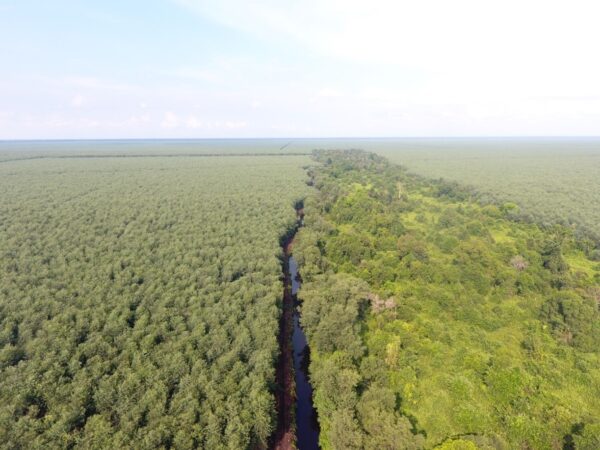
Hailed as a triumph for sustainable business practices when it was passed into law in 2022, the EU Deforestation Regulation (EUDR) was supposed to inspire similar laws from the EU’s economic rivals.
Yet three years on, the environmental NGO World Wildlife Fund (WWF) says that all that has been delivered are “two delays and a revision”.
The EUDR’s due diligence requirements have been stripped down by around 75 percent and will not apply to small businesses and farmers until December.
How did a law that was drawn up to require businesses trading cocoa, coffee, timber, palm oil and rubber to ensure that their products were not linked to deforestation anywhere in their supply chain, get so messy?
The aim of the regulation is to require sellers of beef, coffee, chocolate, palm oil and wood to show their goods can be traced to land that has not been deforested.
Few dispute that the deforestation regulation is a fundamentally well-intentioned law.
But the roots of the difficulties in implementing it probably lie in the European Commission’s initial impact assessment.

The commission’s failure to adequately cover the costs to farmers in its impact assessment left a series of problems that were only addressed after the bill had been passed into law.
Research by the London-based Commonwealth Secretariat last year estimated that African farmers stood to lose about $11bn [€9.4bn] in export revenues if they fail to comply with the new law.
For example, more than 55 percent of Nigeria’s cocoa exports of $543m a year, went to EU customers between 2019-2023. And Ethiopia’s 2.2 million coffee-farming families sell a substantial percentage to the EU market.
That left the EU scrambling to provide financial support to countries across Africa to pay for track-and-tracing programmes.
Compliance burden
The EU Commission has provided significant financial and logistical help for farmers to cope with the compliance burden in countries such as Ivory Coast, Ghana, Ethiopia, and Uganda.
Last April, EU commissioner for environment, oceans, and fisheries, Virginijus Sinkevičius, announced several EU-funded programmes to help African states implement the new regime.
These included an additional €50m in budget support and €15m for forestry for the Ivory Coast, the world’s biggest cocoa producer.
Uganda, meanwhile, was granted up to €40m to finance projects under the Forest Partnership.
Some countries have been better prepared than others. In Ivory Coast, for example, around 900,000 of its million cocoa farmers have received digital ID cards that may help with EUDR compliance.
In Cameroon, officials say 24,800 cocoa farmers have been registered as part of a national traceability system covering more than 28,000 cocoa plots that have been geolocated.
Moreover, the cocoa and coffee industry, in particular, have invested millions of dollars in preparing for the new regulation.
Mars, Nestle, Ferrero and Mondelez have been among the staunchest supporters of EUDR since its inception. When the EU commission threatened to delay implementation by a second year last autumn, these chocolate producers replied that they had invested heavily in being able to meet the compliance burden.
Meanwhile, a group of major coffee companies have formed the Coffee Canopy Partnership, including JDE Peet’s, Tchibo, Louis Dreyfus Company, Neumann Kaffee Group, Touton and Sucafina.
They have purchased high-resolution satellite imagery from Airbus to produce detailed maps of coffee-growing areas. The system identifies where farms intersect with forest zones or areas of recent forest loss.
The satellite system has begun in east Africa, covering Ethiopia, Tanzania, Kenya, Uganda, Burundi and Rwanda, a region that forms a critical pillar of global coffee supply, and where there is a high concentration of smallholder farmers.
IT flaws and snarl-up in system
The other major problem that emerged to face the EU executive was whether its new IT system would be able to cope with the volume of due diligence statements. Having initially estimated that 100 million due-diligence statements (DDS) would be lodged each year, EU officials said last autumn that they expected up to one billion to be made by hundreds of thousands of registered operators.
The result was a proposal to require only one submission in the EUDR IT system for the entire supply chain, with the liability resting on importers to the EU market.
But the sudden reluctance of the EU commission, and its member states, to ambitiously implement EUDR, combined with the EU’s broader trade agenda, also encouraged countries, notably the US, Brazil and Indonesia, to demand exemptions from EUDR.