
On his path to rolling back illiberal rule, Hungary’s newly elected prime minister has found an ally in a veteran of European politics – Poland’s Donald Tusk. The question now is how far that playbook can travel – and where its limits lie.
 Ada Petriczko



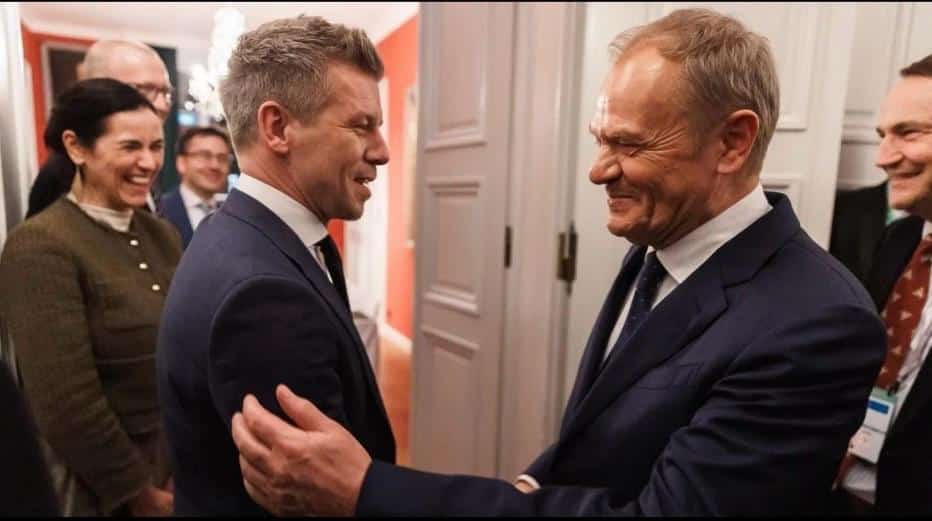
If the bilateral reset with Warsaw offers Magyar a pragmatic entry point, his ambitions appear to stretch further to the regional stage, where he is already signalling an effort to breathe new life into Central European cooperation. In that vision, the Visegrad Group – long paralysed by internal rifts – could be revived and even expanded into a looser V4+ constellation, extending beyond its traditional members to include countries such as Austria, Croatia or Slovenia.
“Strengthening Central European regional cooperation plays a key role in the strategic thinking of the incoming administration,” Hegedus comments.
Yet even if the political will exists, alignment between Magyar and Tusk is still far from guaranteed, with Ukraine likely to be the first real point of friction.
Budapest under Magyar will likely side with the Czech Republic and Slovakia in declining to support the EU’s €90 billion loan plan for Ukraine. The three also differ in their positions on Kyiv’s path toward EU membership.
“Ukraine has clearly benefited from Orban no longer being in power – but that doesn’t mean it has gained a real ally,” Mazzini says. “What it has lost is a major antagonist.”
The same ambiguity applies to the broader relationship with the EU. Magyar has signalled a willingness to re-engage, but how far that shift will go remains unclear – and may depend to a large part as much on domestic constraints as on external expectations.
“Magyar’s politics – especially on foreign policy – are far from liberal,” Mazzini says. “Nor is he clearly pro-EU, at least in any straightforward sense.”
In some respects, he adds, Magyar may have more in common with Italy’s Giorgia Meloni than with Tusk.
Since 2022 and Russia’s full-scale invasion of Ukraine, Poland’s regional focus has shifted decisively northward—toward the Baltic states and especially in the realm of security cooperation—at the expense of Central Europe, Hegedus argues. While Budapest’s overtures might “contribute to a more nuanced and balanced geopolitical approach in Warsaw,” he suggests they are unlikely to alter that trajectory in any meaningful way. In his view, Hungary “simply lacks sufficient strategic weight,” particularly in the areas that matter most to Polish strategic and security thinking.
For now, the emerging Magyar-Tusk alignment remains more promise than policy. “The real test,” Munk believes, “will be whether this partnership can sustain momentum beyond the initial transition period and deliver tangible institutional and diplomatic results.”
Here, she points out, coordination on the rule of law, EU cooperation and security, particularly in relation to Russia and Ukraine, will be key.
Mazzini, too, remains cautious. “What Magyar ultimately does with his views remains an open question,” he says. “One can just as easily imagine a scenario in which the Polish and Hungarian prime ministers don’t fully align, and Magyar positions himself as a more pragmatic actor.”
In practice, that would mean still being critical of some EU policies, but less openly confrontational and more compromise-seeking in serving Hungary’s interests.
The Budapest–Warsaw rapprochement may be gathering pace. But it is only when interests begin to pull in different directions that its durability will be tested.