In one axis, the Russian air force dropped 727 various types of guided bombs, but only 419 hit their target.
 Roman Pataj



Every day, the Ukraine Battlefield update newsletter offers a clear look at how the war is unfolding on the ground, highlighting key developments along the frontline and the shifting dynamics of the conflict. This offers readers regular and detailed information to better understand the implications of the war for the country and the whole continent.
What is the current state of the air war. The Druzhba oil pipeline in the Ukrainian town of Brody will operate, but in the Russian city of Samara it may not last long. How Ukrainian drone attacks are expanding – there are more and more of them and they are reaching ever deeper. What is new on the Sloviansk axis. Russia is failing on the main axes and is consoling itself with secondary ones. Maps of the day – Sloviansk axis, Kharkiv front Videos of the day – Mirage 2000 at low level; how an FP-2 drone raid unfolds, from pre-flight preparations through launch to the strike itself
What is the current state of the air war? One Russian and two Ukrainian authors, either close to military aviation or directly fighting at the front, have recently described the state of the air war at the end of winter and before the start of the summer campaign. Each of them published interesting details about how the fighting in the air was unfolding, revealing the tactics of both air forces and the constraints they are struggling with.
Their reports on the effectiveness of individual weapons are very important. The Ukrainians add details about how Russia is deploying rookies and veterans.
We will start with the best-known account, the Russian Fighterbomber; after that, two Ukrainian authors get space.
What are Russia’s experiences. At the very beginning, the Russian admitted that both sides already knew each other so well that they were no longer able to surprise one another. The only area where, in his view, the superiority of the Russian air force was evident was in the number of aircraft, which allowed for a higher number of missions and strikes.
However, given that along the entire front both armies had built an “effective system of airspace control to a depth of hundreds of kilometres, air battles, air-defence work and bombing always look the same”.
According to the Russian blogger, every single aircraft was always precisely informed about where the boundaries lay beyond which its destruction threatened. It knew exactly the position of enemy aircraft and did not approach their range. And everyone could see every single aircraft.
The same applied when any missiles and precision-guided bombs were launched, as they were also visible on radar. “Therefore the enemy would hide in advance (sometimes 15 minutes before impact) in a safe place or simply leave the facility at the time of the attack. That affects effectiveness, but it does not affect presentations, reports and the payment of bonuses for ‘hit’ targets. And everyone is fine with that,” Fighterbomber wrote.
He said that air-to-air combat had almost ceased and that pilots only occasionally fired air-to-air missiles at each other from long range, in some cases hundreds of kms. The same was allegedly true of the S-400 and Patriot air-defence systems.
The most important message from Fighterbomber was the declining effectiveness of Russian glide bombs. As an example, he mentioned an unnamed axis where, over three months, the Russian air force dropped 727 various types of guided bombs, of which only 419 hit their target. He attributed this to the increasing effectiveness of electronic warfare on both sides. He admitted that effectiveness was continuing to fall and would get worse.
What the Ukrainians say. The Telegram account Slnečnica published interesting details about Russian tactics. It said that Russia had used the winter period to train up newcomers, with them operating along the entire front.
Among the aircraft types, the Su-35 was the most frequently used; in the south, the twin-seat multirole Su-30s were somewhat more active. Escorting bomber aircraft was mostly the responsibility of experienced Russian pilots, but in the south this task was also carried out by “greenhorns who – by the way – are being very nicely chased by our F-16s”.
Russian fighter pilots used a tactic in which they patrolled at low altitude so as to hide from radar and ambushed incoming Ukrainian aircraft. During the chase they fired two R-77 missiles at once and, within 30 seconds, one R-37.
Slnečnica said that over Kursk and Belgorod regions both sides were passive; by contrast, Russia most often used its most modern Su-57s over Bryansk region, where they covered S-300/S-400 air-defence batteries or Iskander launchers. Deeper in the rear, even MiG-29 fighters – clearly the most obsolete fighter type of the Russian air force still in active service – took part in hunting Ukrainian drones.
Another Ukrainian account also spoke up. Behind the nickname Air Fighter was a member of the Ukrainian air force who commented on the above-mentioned Russian R-77 and R-37 air-to-air missiles, which, according to him, “either fail to reach their target or become ineffective under the influence of electronic-warfare means”.
He repeatedly wrote about the ineffectiveness of Russian missiles. He did so again in this post, in which he said in general that their effectiveness “was, to put it mildly, questionable”. Besides the air-to-air missiles, he said the same about Kinzhal missiles and the surface-to-air missiles used in S-400 systems.
“It plays into our hands. They are spending billions on weapons that often do not deliver the expected result,” he said.
The Druzhba oil pipeline in the Ukrainian town of Brody will operate, but in the Russian city of Samara it may not last long. After more than three months of downtime, Russian oil again began to flow to Slovakia through the Druzhba pipeline. Russia bombed the facility on (18 January). Although Russian oil flows through this town, another pipeline from the south also connects here, carrying non-Russian crude.
It might seem that this resolved the political problem which the pro-Russian Slovak prime minister had used to criticise Ukraine, but it cannot be ruled out that this was only a temporary state of affairs. Ukrainian drones for two nights in a row attacked Samara region in Russia and oil infrastructure in Samara itself, as well as in the city of Syzran.
For Slovakia, but also for the overall picture of Russian oil supplies to Europe, it was crucial that Samara was exactly where smaller pipelines from the eastern part of Russia converged and where the Druzhba pipeline de facto began. If Ukraine put this hub out of operation, the fact that the pumping station in Brody was working again would be irrelevant.
How Ukrainian drone attacks are expanding – there are more and more of them and they are reaching ever deeper. This was illustrated very clearly by a time-lapse map produced by a Ukrainian NGO. The authors marked the past year as a turning point, when the number of attacks began to rise steeply.
For instance, in January 2024 they sent 110 unmanned aircraft over Russia, while in March 2026 more than 7,000 were already carrying out attacks.
You do not need to be an air-defence expert to see from the graphic representation what a huge burden this trend placed on Russian air-defence batteries. Not only was the number of drones increasing, but the number of threatened regions also rose dramatically. The Russian army therefore had to deploy its shrinking resources over an ever larger area.
Over the past year, Ukrainian long-range drones have become a far more prominent factor in the war. Their numbers have increased to a level comparable with Russian attacks, and the geographic scope of their use has expanded significantly. These changes reflect a gradual build-up… pic.twitter.com/6AaG6FkgaH
— CBA Initiatives Center (@cbacenter_ngo) April 21, 2026
What is new on the Sloviansk axis. “Only a few weeks remain before the start of the main battle of 2026. Another week or two and everything will start moving. The enemy has to guess exactly where we will deliver our main blow. For our part, we must not only try to prevent him from finding that out, but also strip him in advance of any possibility of seizing the initiative,” wrote the large, Russian pro-war account run by Yuriy Podolyaka, Yura Sumy.
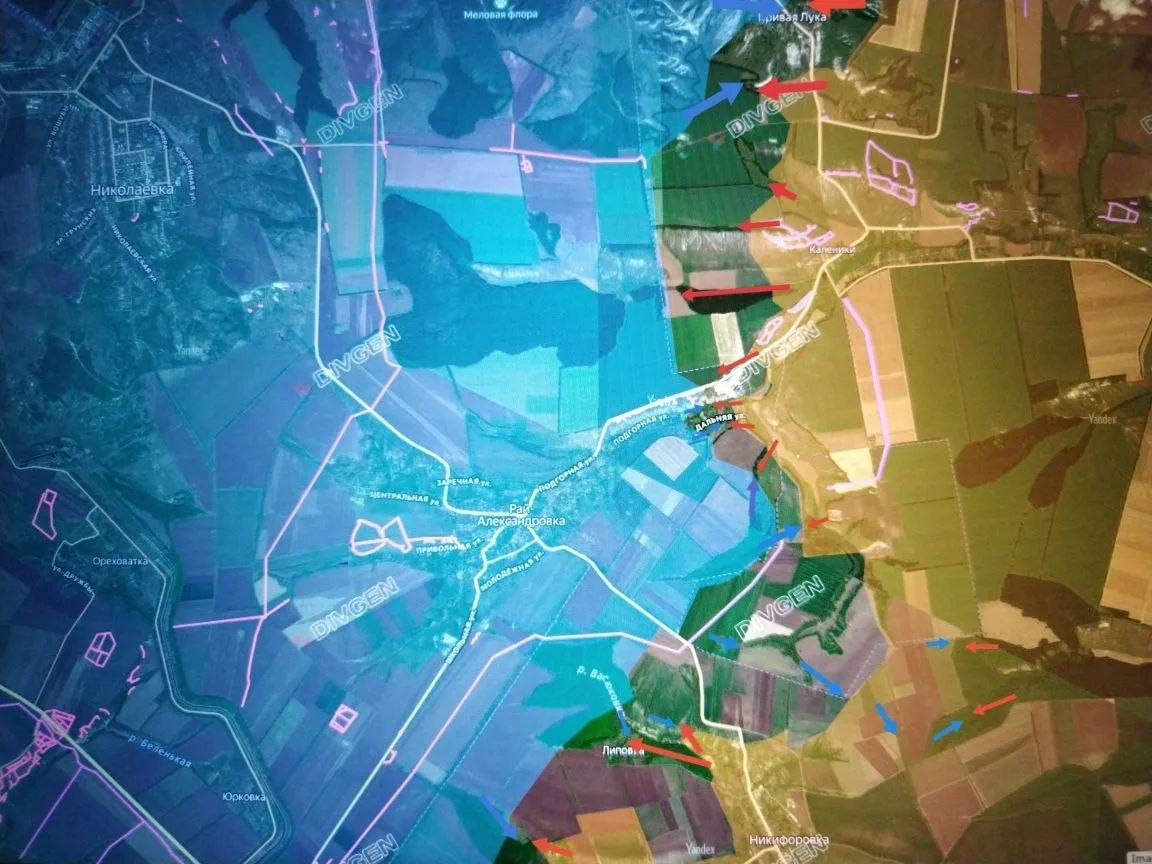
He might be right, or it may be an information game, but the current situation is such that Russia’s efforts to advance have reached a stage best captured by this sentence from Russian Z-blogger Yuriy Kotenok: “Our assault groups advanced in the area of the Rosypanaya ravine and took control of its central and northern parts.”
He added further snippets about advances here and there, about an alleged entry into Rai-Oleksandrivka and so on, but for months now Russian frontline reporting has been talking about progress in some ravine or other in order to present some kind of success.
Kotenok went on to write about attacks from the village of Kalenyky, about clearing the forest to its south-west, and similar operations. On his map, Kalenyky can be found in the middle of the upper right quadrant.
Ukrainian military blogger Oleg Petrenko also focused on this area on Wednesday, but according to him the situation was entirely different. On his map, Kalenyky (bottom left) was under Ukrainian control and Russian forces were only approaching it from Riznykivka.
It was precisely in its vicinity that Petrenko saw the only confirmed Russian advance towards Rai-Oleksandrivka. From these positions it was roughly 10 km away in a straight line. According to Kotenok’s map, from this direction they were about 3 km short of the key defensive hub.
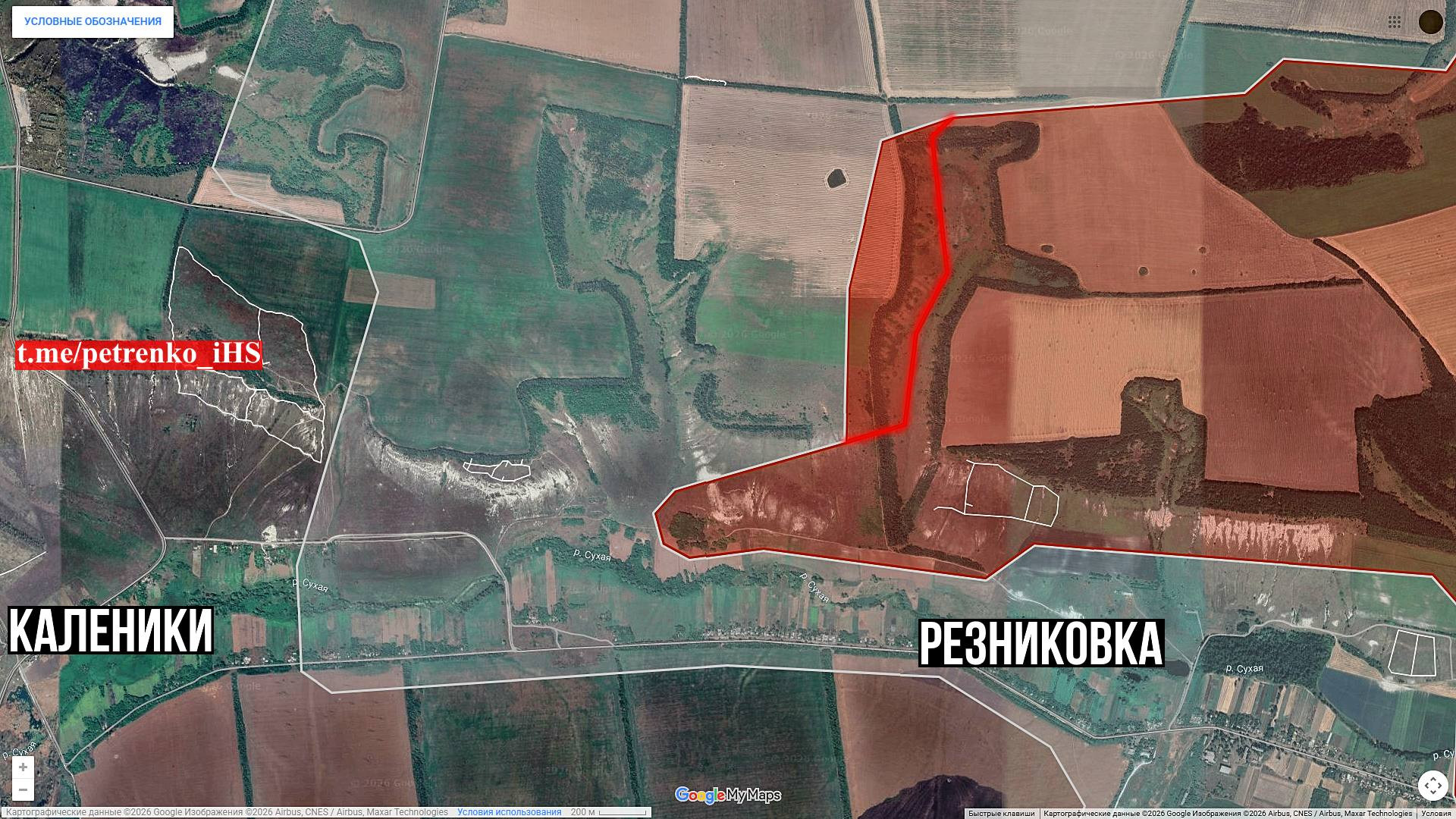
Even Petrenko admitted that Russian forces were closer to Rai-Oleksandrivka, but they were not approaching it through Kalenyky, rather further to the south.

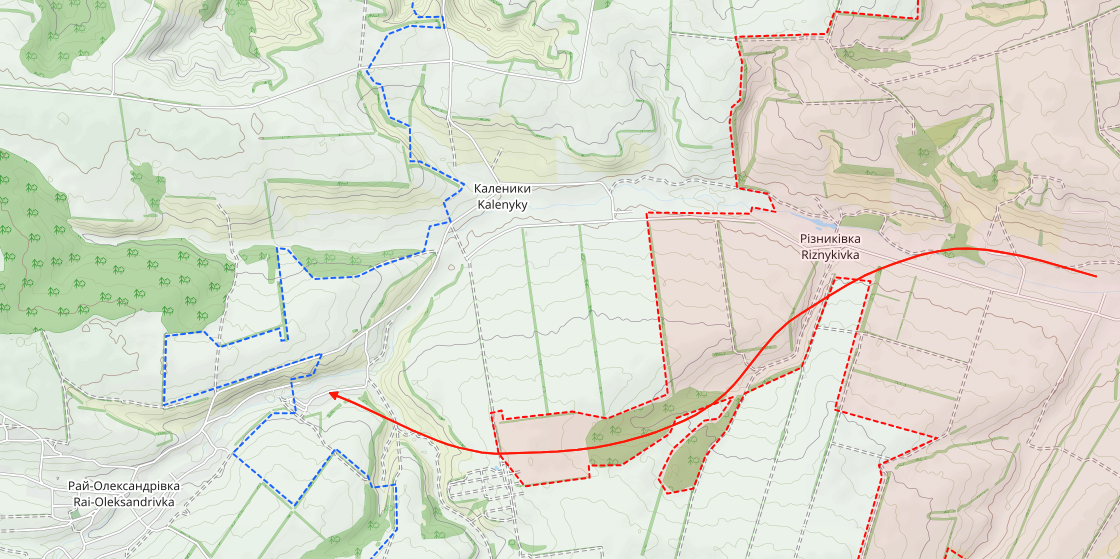
For comparison, here is the map by the Finnish OSINT group Black Bird Group, whose version was very similar to Petrenko’s:
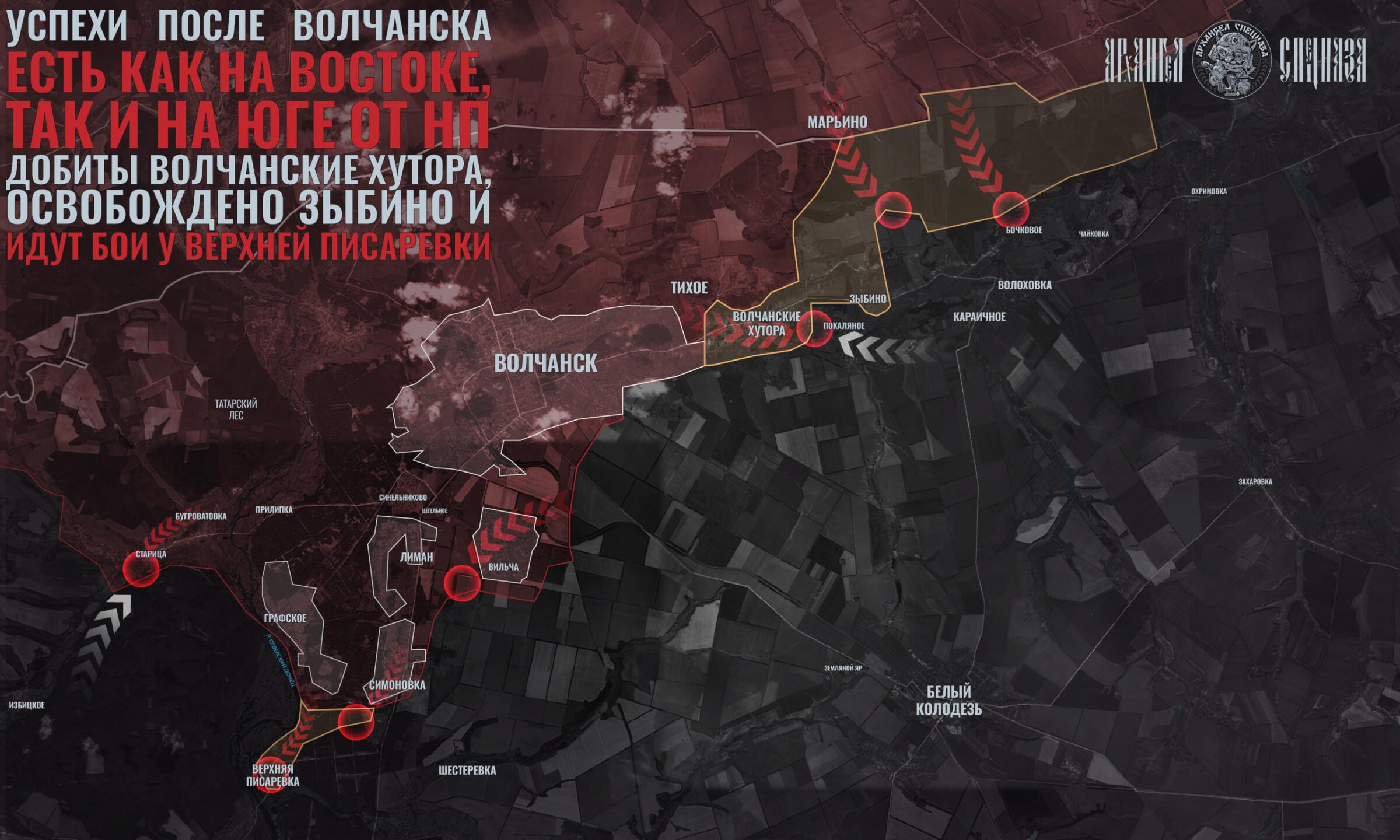
Russia is failing on the main axes and is consoling itself with secondary ones. We have already written about the buffer zone in the east of Sumy region, where Russia managed to create a narrow strip of territory from which it pushed out the Ukrainians. Now the focus is on Kharkiv region, specifically the area around the town of Vovchansk.
“At present, the key task of the Russian armed forces on this axis is to create a stable bridgehead on the left bank of the Vovcha river, where the heaviest fighting is taking place. The Ukrainian army is holding the high ground, ‘gnawing away’ and launching counterattacks, which leads to protracted battles over small villages,” the large Russian account Archangel Spetsnaza reported.
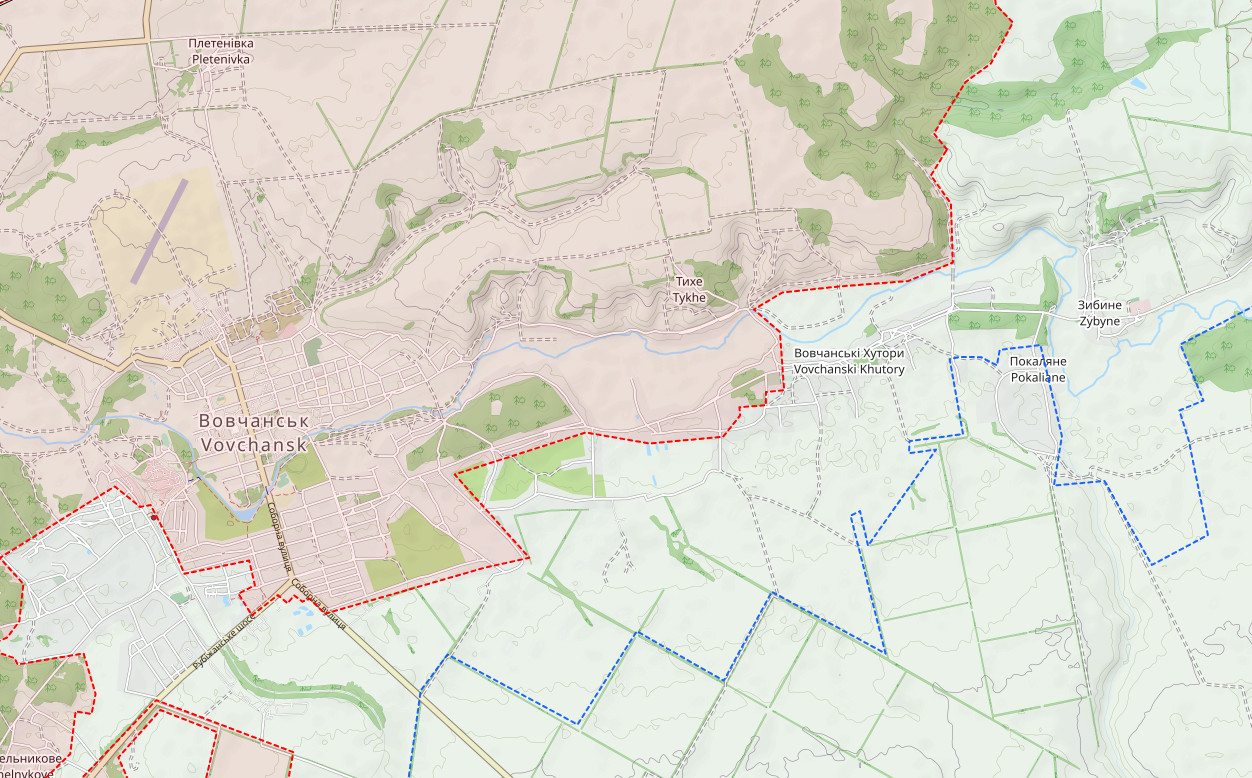
The post began with a sentence saying that it had not covered this sector for some time, but that according to it the Russian army had “achieved certain successes” there. Specifically, it claimed to have captured the village of Vovchanski Khutory and also occupied the village of Zybyne, reaching the Vovcha river.
As in Kotenok’s case, other sources did not confirm the Russian claims here either. Oleg Petrenko not only regarded Zybyne (centre right) as firmly in Ukrainian hands, but said the same applied to the village of Vovchanski Khutory.
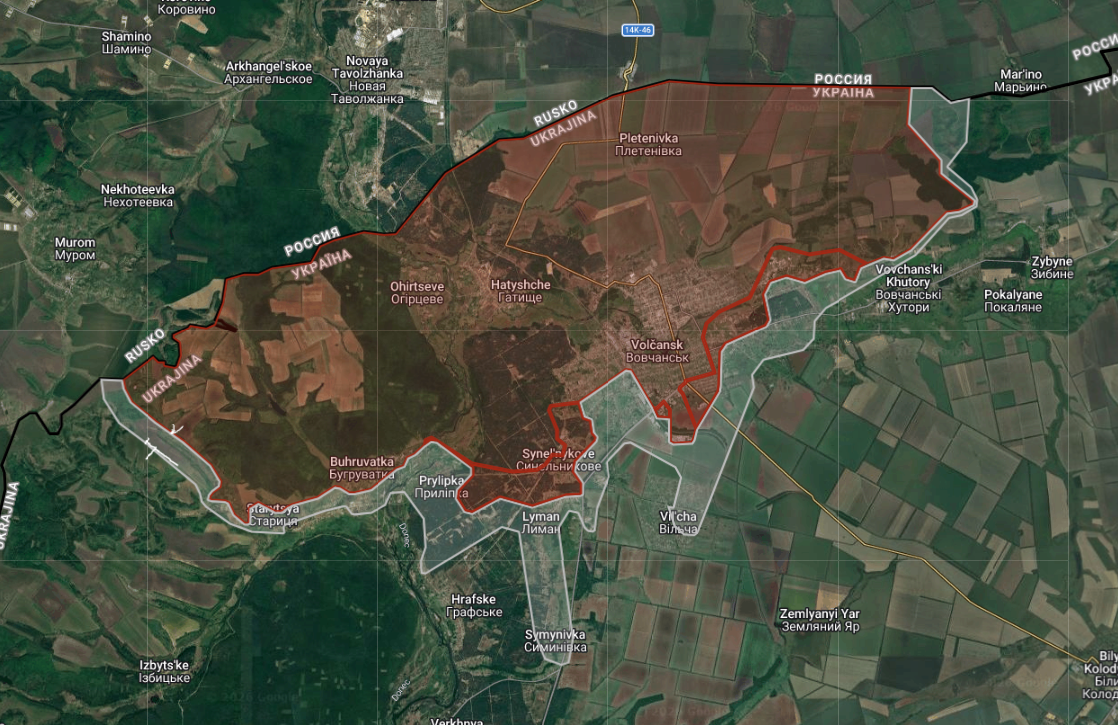
The map by the Black Bird Group this time lay somewhere between the Russian and Ukrainian sources. Both villages were shown in a grey zone on their map.
Videos of the day
Less attention was being paid to French Mirage 2000 fighter jets than to the F-16s Ukraine received from European allies, but they were also fighting intensively. This particular aircraft was returning from a combat mission, as evidenced by the empty weapon pylons. Under its wings there were only external fuel tanks in a yellow-blue anti-camouflage scheme, so that it was clearly recognisable from the ground.
One of the most successful weapons on the battlefield at the moment were Ukrainian FP-2 drones, which attacked elements of the Russian army in its rear areas behind the front. In this video you could see their preparation on the ground, launch, and a compilation of several typical strikes.
🔥 Unique footage of the preparation and launch of FP-2 guided kamikaze drones during night operations by Ukraine’s Unmanned Systems Forces (@usf_army). pic.twitter.com/TB1iaONH4H
— Special Kherson Cat 🐈🇺🇦 (@bayraktar_1love) April 21, 2026
What are the losses
No update on Wednesday.
By Tuesday morning, Russia had demonstrably lost 24,471 pieces of heavy equipment (on Monday (13 April) it was 24,440). Of these, 19,108 (19,079) pieces were destroyed by the Ukrainians, 976 (975) were damaged, 1,206 (1,205) were abandoned by their crews, and 3,181 (3,181) were captured by the Ukrainian army. This included 4,385 (4,381) tanks, of which 3,288 (3,284) were destroyed in combat. Ukraine had lost 11,977 (11,923) pieces of equipment, of which 9,224 (9,175) were destroyed, 669 (668) damaged, 670 (666) abandoned, and 1,414 (1,414) captured. This included 1,416 (1,412) tanks, of which 1,081 (1,078) were destroyed in combat.
Note: Neither side regularly reports on its dead or on destroyed equipment. Ukraine publishes daily figures for Russian casualties and destroyed equipment, which cannot be independently verified. In this overview we use data from the Oryx project, which since the beginning of the war has compiled a list of equipment losses documented exclusively by photographic evidence.