
The EU Commission and the rotating EU presidency invited the IMF to press ministers to rein in untargeted measures shielding households and businesses from the energy shock from the Iran war.
 Wester van Gaal



Divisions are emerging among EU member states over how to respond to the latest energy shock triggered by the conflict in Iran.
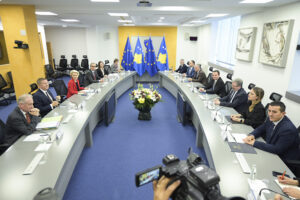
European finance ministers meeting in Brussels on Monday (4 May) debated how far governments should go to shield households and businesses — and who should ultimately bear the cost.
Some governments have already rolled out broad support schemes, while others have limited intervention to targeted aid for vulnerable households and firms.
Against that backdrop, the International Monetary Fund (IMF) was invited to press ministers to rein in untargeted measures and focus instead on income support for those most exposed.
“The measures should be tailored and targeted,” Greek finance minister and Eurogroup president Kyriakos Pierrakakis said. “That is why we are trying to coordinate action and why we have invited the IMF to look into the appropriate response.”
Frugal member states voiced irritation at what they see as a push towards looser spending rules, an idea floated by some member states.
Dutch finance minister Eelco Heinen said as he arrived that support should “remain strictly targeted,” adding that it’s “always easy to spend other people’s money.”
Overall, EU governments have committed around €10.5bn, according to the Bruegel economic think-tank, with roughly 80 percent consisting of untargeted measures such as broad fuel tax cuts and VAT reductions.
Dutch support — a little under one billion euros — is significant, but mostly targeted at vulnerable incomes and businesses, according to the think tank.
Other member states such as Spain, Germany and Ireland instituted mostly untargeted measures aimed at lowering general fuel and power costs.
In March, Spain approved a €5bn support package, the largest so far. Germany coming in at €1.6bn is number two.
Belgium’s budget minister Vincent Van Peteghem warned that such measures risk “stimulating demand” for fuels, pointing in particular to across-the-board fuel tax cuts.
Bruegel does mention an “important caveat” in that their data only tracks clearly defined budget amounts.
This is especially relevant for the detailed 153-page Spanish decree where many of the structural measures aimed at boosting cleaner energy alternatives either don’t have such figures or are framed as guarantees, meaning most of the measures are not counted.
Fiscal debate