

The current energy crisis caused by the war with Iran could have hit Europe much harder, were it not for lower gas consumption and a marked shift towards renewable sources.
 Tomáš Grečko



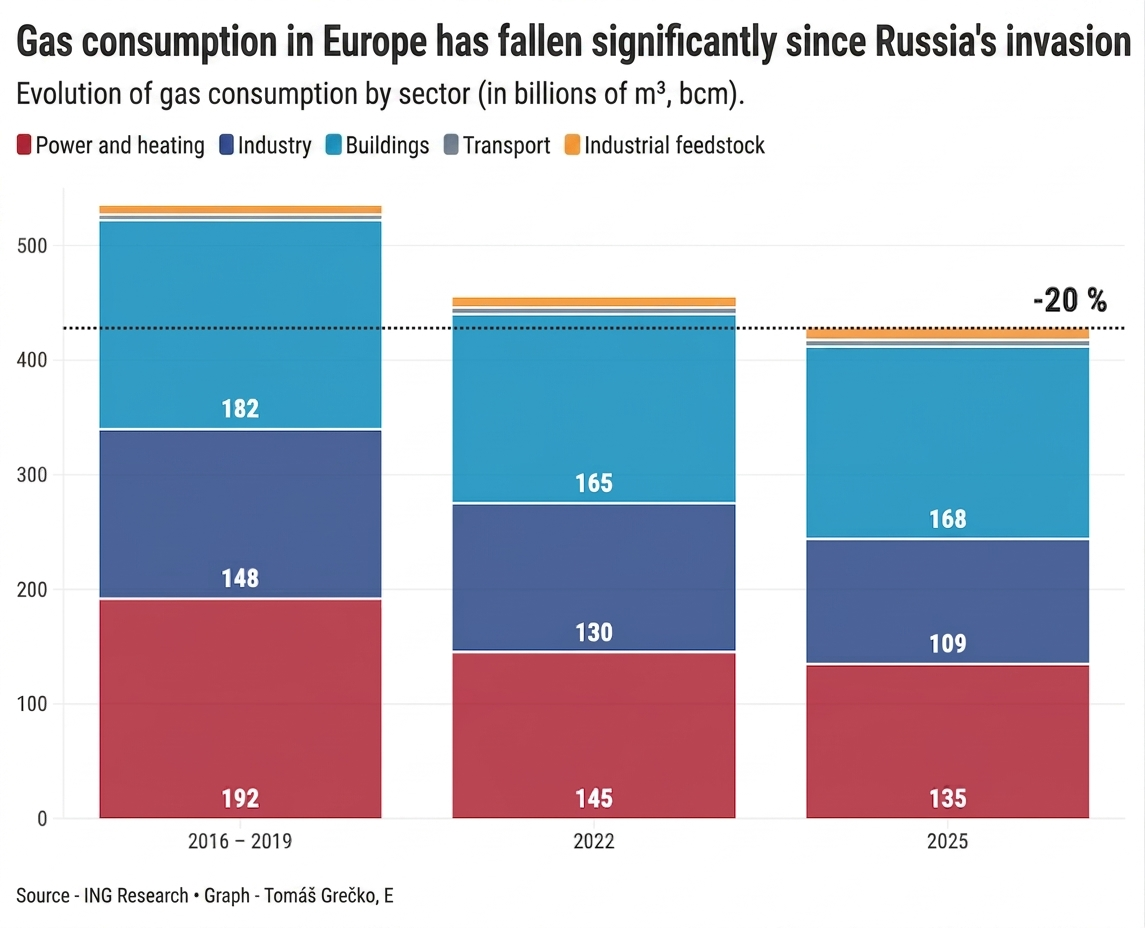
The current energy crisis caused by the war with Iran could have hit Europe much harder, were it not for lower gas consumption and a marked shift towards renewable sources.
This follows from analyses published by ING analysts and the Ember think tank.
Compared with 2020, total gas consumption has fallen by one-fifth. In the sectors of electricity generation and district heating the savings were even more pronounced. Gas consumption there fell by as much as “an impressive 30 percent”, ING stated. This was achieved mainly thanks to a stronger shift towards renewable energy sources.
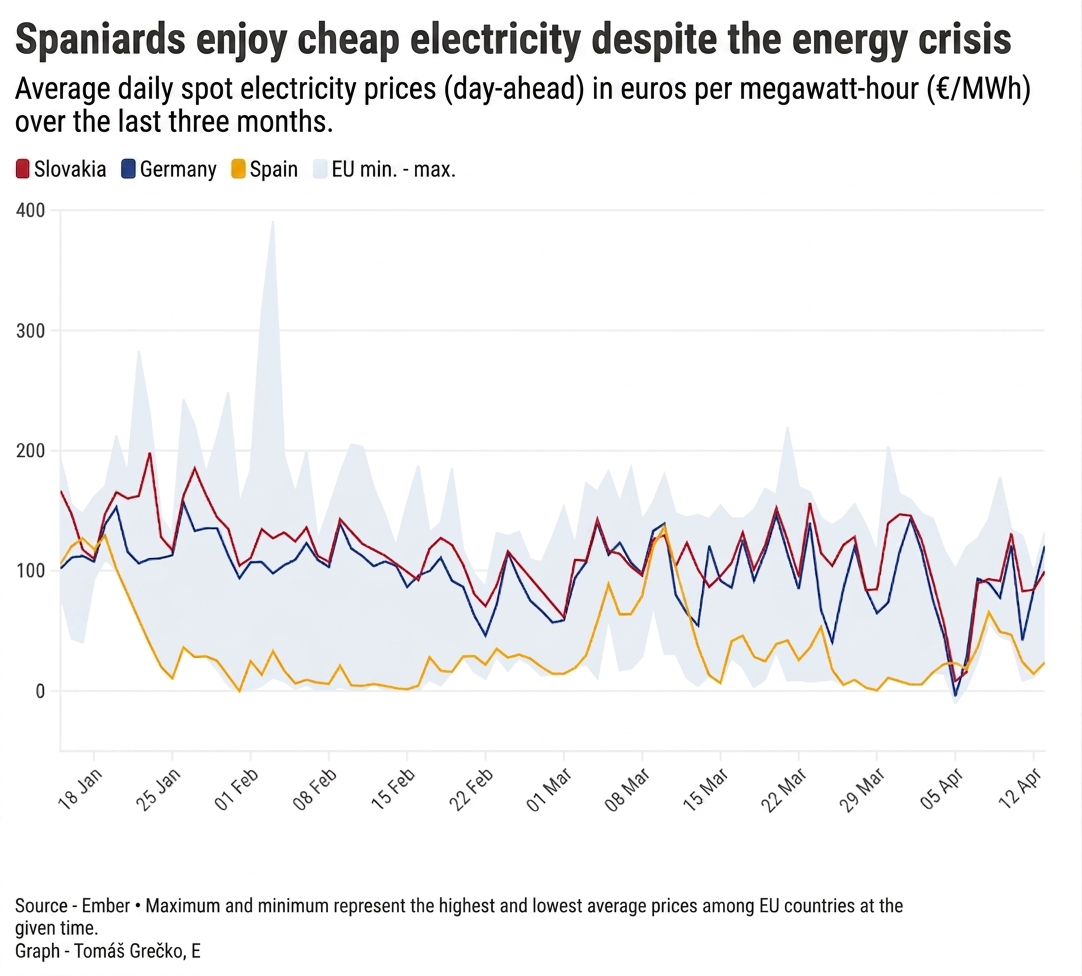
Spain is among the countries that have learned the most from the Russian invasion. It has managed to weaken the link between gas and electricity prices. Thanks to this, electricity remains cheaper even at a time when gas prices on global markets are rising – that is, right now.
How we are saving on gas – and Spain as a laboratory of the energy transition
Solar power plant Gemasolar in Spain uses thousands of mirrors (heliostats) that concentrate solar radiation onto a central tower where electricity is generated. Source: Beyond Coal & Gas (licence CC BY-NC 2.0)
The decline in gas consumption has resulted from a combination of several factors – some are positive and sustainable in the long term, others are more of a side effect of economic slowdown.
The energy sector played a key role. It was there that it became clear the shift to renewables could have an immediate effect. Gas consumption for electricity and heat generation in the Union fell by up to one-third, mainly because it is being replaced by wind and solar power plants.
This shift is fundamental because it is not a short-term effect. Gas is simply ceasing to be used where cheaper sources are able to replace it.
We are learning to heat differently: An interesting shift has also taken place in households, although it is less visible. Gas consumption in buildings has fallen by roughly eight percent, which analysts attribute to a combination of savings and technological change. People have lowered the temperature in their homes, invested in insulation and are increasingly switching to heat pumps.
The decline in industry is less encouraging: There, gas consumption has indeed fallen significantly, by as much as 26 percent, but the reason is less positive. “Lower gas consumption is often more the result of plant closures and deindustrialisation than of improved efficiency,” the analysts concluded.
A fundamental risk remains: Europe may be using less gas, but it is still heavily dependent on it. It imports roughly 70 percent of its consumption, mostly from Norway, followed by liquefied gas from the US.
Russia’s share has fallen since 2022 from around 40 percent to roughly 13.
Further reducing consumption will be more difficult: Cutting demand for gas is possible, but it comes with significant challenges and sacrifices, the analysis warned. In households there is little room left for additional savings – people are already heating less and further restrictions would mean a loss of comfort. In industry, another drop could in turn mean factory closures.
Spain and its solar miracle: In the European system, the price of electricity is set by the most expensive source needed to cover demand – and this is often gas-fired power plants. If there is a lot of gas in the mix, its price is automatically reflected in the bills of all consumers. Spain, however, has managed to weaken this mechanism.
In recent years it has sharply increased wind and solar capacity, which today covers almost half of its electricity consumption. The rapid growth of renewables has meant that while in 2019 gas set the price of electricity in roughly 75 percent of hours, today it is in less than 20 percent. In Italy, which has a similar climate, it was as high as 89 percent of hours since the beginning of the year. Wholesale electricity prices in Spain are significantly lower than in countries that rely more on gas – in the first half of 2025 they were roughly 32 percent below the European Union average.
The effect of the Spanish blackout: The power outage in April 2025 raised doubts there about whether the rapid expansion of renewables was threatening grid stability. The infrastructure simply cannot keep pace with their growth.
Grid operators have become more cautious after the blackout and are more frequently bringing gas-fired power plants into the system of balancing services, even when they would not be needed for electricity generation itself.
Conversely, the rate of “curtailment” of renewables – that is, clean energy that is generated but not used – has risen from an average of two percent to seven.