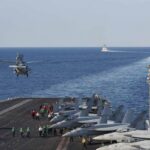

The Black Sea Fleet’s “only function is basically to fire Kalibrs [missiles] from the pier” at Ukrainian drones in self-defence, said one Russian commentator.
 Roman Pataj



Every day, the Ukraine Battlefield update newsletter offers a clear look at how the war is unfolding on the ground, highlighting key developments along the frontline and the shifting dynamics of the conflict. This offers readers regular and detailed information to better understand the implications of the war for the country and the whole continent.
What do we need warships for if they do not fight, Russians asked? The Skala assault regiment violated soldiers’ rights much more often than other units. There was fighting even during the ceasefire, but much less intense. Russia captured Myrne near Huliaipole, otherwise movements on the front were minimal to non-existent. Maps of the day – Huliaipole; Kostyantynivka. Videos of the day – what was sci-fi in 2022 is now reality; Su-25 drops French guided bombs; two US soldiers tried what it is like to fight a drone.
What do we need warships for if they do not fight, Russians asked? “The Black Sea Fleet was, to put it mildly, not sufficiently involved in combat operations and was not entirely capable of fighting at sea against an adversary such as the Ukrainians,” complained the author of a major blog with half a million readers, German Kulikovsky, on Telegram.
He was one of the Russians who set about analysing the state of the Russian navy after the most recent attack so far on its base in Novorossiysk, during which drones hit one of the Grigorovich‑class frigates.
🔥🚢Ukrainian Unmanned Systems Forces drones struck the Russian Admiral Makarov (or Admiral Essen) frigate in the port of Novorossiysk overnight on April 6 with the FP-1/FP-2 guided strike drones!
Project 11356R frigate, is armed with up to 8 Kalibr cruise missiles and 24… pic.twitter.com/dK9DdzVLLC
— Special Kherson Cat 🐈🇺🇦 (@bayraktar_1love) April 6, 2026
Other influential pro-war authors, besides Kulikovsky, also published their views on the performance of the Black Sea Fleet. They did not explicitly use the word ‘defeat’ in connection with it, but they were open enough to make it clear that this was exactly what they thought.
“It does not take an academic for everyone to see that the Black Sea Fleet has dropped out of action and that its only function is basically to fire Kalibrs from the pier,” Kulikovsky wrote. Kalibrs are cruise missiles; against Ukraine they are launched, among others, by the Grigorovich‑class frigates, and there really have been documented cases where, out of fear of Ukrainian drones, these weapons were launched directly from their moorings in port.
“Are the admirals thinking about achieving naval superiority? Are they thinking about how to blockade Odesa and other small enemy ports through which weapons flow? Are they thinking about how to protect our shipping in the Black Sea? Probably yes, but so far they have not come up with anything fundamental,” the author complained.
The idea that Russia could today blockade the port of Odesa is even more unrealistic than it was in 2022, when they were considering it, but it reflects frustration with the performance of a wartime navy that has already lost 32 ships and boats, including the flagship of the entire fleet, the cruiser Moskva, and a submarine.
The highly influential Rybar accused the navy of passivity and of merely waiting in port for further air strikes that would inevitably come. The Black Sea Fleet initially fled from Sevastopol to Novorossiysk to escape them, but it is now clear that this was not far enough away.
“From Novorossiysk there is nowhere to go. The ports in Sochi and Ochamchire are small, and without adapting to the existing threat the fleet remains a fat, tempting target. The key mistake is that in some high offices they are not even trying to grasp the scale of the potential consequences,” Rybar warned.
Dvaja majori saw the reason in the ossification of the naval command, which had been evident since the start of the invasion, he said. However, they were the only one of the quoted sources who also perceived political motives behind the fleet’s inaction.
“The answer is apparently something else (than the navy’s incompetence). It lies in the fact that, at the political level, Odesa and Mykolaiv are no longer among Russia’s demands during negotiations… Otherwise our submarines would be sinking the enemy’s merchant fleet, the ships would be pushing the line of contact as far away from the Crimean shores as possible and would not be anchored in Novorossiysk,” they said
There was fighting even during the ceasefire, but much less intense. “The Ukrainian Armed Forces violated the Easter ceasefire 1,971 times,” the Russian defence ministry claimed.
“The enemy violated the ceasefire 10,721 times,” the Ukrainian General Staff stated in its position paper.
Reports of continuing violence also came from soldiers at the front. “In the distance I can hear explosions right now, there are fewer of them, but they are there. Just like last year, a vague hope is smouldering in my soul, but I am not giving in to it,” wrote the Ukrainian soldier with the call sign Bakhmut Demon on Saturday evening (the ceasefire started on Saturday at 4PM).
The Ukrainian analyst Bohdan Myroshnykov was also highly sceptical. He published his post an hour and a half before midnight on Saturday. In it, he claimed that the ceasefire essentially did not exist.
The number of sectors where fighting was taking place remained the same and, although the number of attacks had fallen, drones had not stopped flying and aerial bombs had not stopped hitting Ukrainian positions. “In short, there will be no real ceasefire without a clear and tough stance from the US, without clear rules of the game, without monitoring and holding those who break them accountable,” he saaid.
“Ceasefire has already been in effect for 4.5 hours, it is really quieter in our sector,” the Ukrainian soldier Kravchuk described the situation on Saturday evening.
He said that despite the easing of tensions, the soldiers at the front continued to watch the Russians: “We can see what they are planning to do in the near future. The growing season will begin soon, and we know with 100 percent certainty about the enemy’s plans to step up attacks. A hot end of spring and an even hotter summer await us, peace is still far away,” he added.
Meanwhile, the Russian military correspondent Alexander Kots commented on photographs of Russian soldiers with white flags previously published by the Ukrainians.
His post started off rationally. He explained that the images showed Russian evacuation teams removing the wounded and the dead. “Someone will save a limb, some family will get, albeit sad, but certainty and the chance to say goodbye in a Christian way; some position will finally receive dried rations and even a few cans of energy drink; somewhere in the front line there will be a rotation of exhausted soldiers who, after a few months without relief, have grown beards and lost weight like Robinson Crusoe,” he said
But then Kots completely let himself go: “We did not declare the ceasefire for the Ukrainians. Nor for the collective West. This pause does not belong to the category of military-political concessions or operational-tactical plans. It belongs to the spiritual, moral and ethical sphere. Once again, we have shown who we are.”
Russia captured Myrne near Huliaipole, otherwise movements on the front were minimal to non-existent. “The Easter ceasefire ended without any changes on the front,” the Russian Telegram channel Dvaja majori stated on Monday morning.
Overall, Russian sources reported very little about what was happening on the battlefield. They were much more interested in the Hungarian elections.
Paradoxically, while Russia claimed there had been no changes, the Ukrainian DeepStateUA reported that the village of Myrne, located to the southwest of Huliaipole in Zaporizhzhia region, had come under Russian occupation.
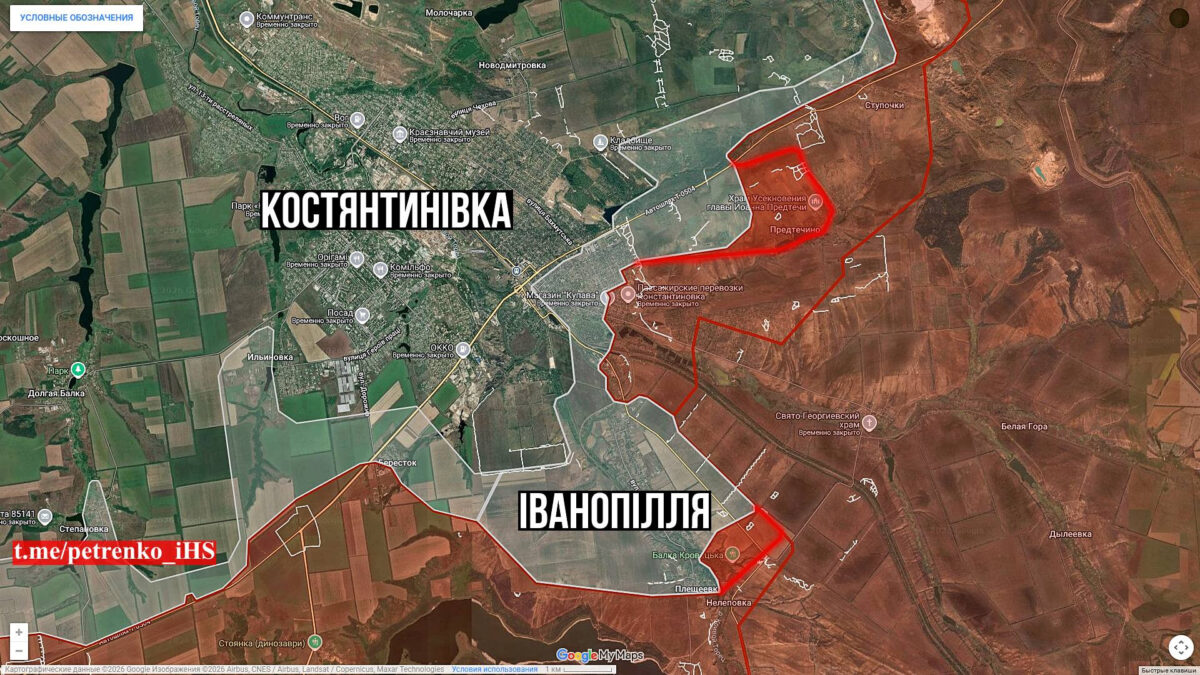
On Monday morning, the Ukrainian analyst Oleh Petrenko drew a map showing how Russian forces had advanced near Kostyantynivka – specifically on the southern and eastern approaches to the town.
The Skala assault regiment violated soldiers’ rights more often than other units. We have written several times recently about Ukraine’s 425th Separate Assault Regiment in connection with a botched attack near Pokrovsk.
This unit, better known under the name Skala, has repeatedly been the target of criticism among Ukrainian soldiers. Last week, Ruslan Tsyhankov commented on conditions in the regiment in an interview for Radio Liberty. In the Ukrainian army he serves as the first deputy military ombudsman. The task of his office is to oversee compliance with soldiers’ rights.
Tsyhankov confirmed that, from this perspective, the problematic units were precisely Skala and also the 225th Separate Assault Regiment, that is, the same type of unit.
According to him, in Skala there had been cases of soldiers being beaten or having their mobile phones taken away under the pretext of security measures, but there was also a suspicion that this happened when the unit’s command wanted to prevent soldiers from using their phones to send complaints.
“These two units, in addition to their effectiveness, represent a very high risk in terms of violations of soldiers’ rights. We are aware of this and are monitoring them,” the ombudsman admitted.
One of the risk factors was the size of these units. Officially they were regiments, but the commander of the 225th Regiment, Oleh Shyriaiev, said that he commanded 15 battalions, which corresponded to an entire division. Yet the Ukrainian army was structured around brigades, which are units in size between a regiment and a division.
As a positive example, Tsyhankov mentioned the 210th Assault Regiment, where there were no problems with violations of soldiers’ rights: “At this point I cannot determine how effective the 210th Regiment is compared with the 225th Regiment, but we would not like certain traditions of these regiments [the 225th and 425th] to be carried over into other units that could theoretically become part of the assault forces,” he said.
The Ukrainian website Militaryland cited data according to which, in March, 20 times more complaints from soldiers came from Skala than from any other brigade. In February, this unit had a manning level of 248 percent.
Videos of the day
Back in 2022, this scene would have looked like something from a sci‑fi film; today, operators control turrets equipped with heavy machine guns to shoot down Russian drones from a room that looks like an ordinary office.
A command post from where operators operate remotely controlled Sky Sentinel turrets equipped with M2 Browning machine guns and repel Russian drone attacks. Control is carried out using regular Xbox controllers https://t.co/HPPZLRYxwW pic.twitter.com/f5FtmGuZU2
— Special Kherson Cat 🐈🇺🇦 (@bayraktar_1love) April 11, 2026
A Ukrainian Su‑25 dropped a pair of French AASM Hammer bombs. This is precision‑guided munition which, compared with other air‑dropped bombs in the same category, has one advantage – at the rear it has an auxiliary rocket motor that accelerates the bomb after release so that, under ideal conditions, it can reach a range of up to 70 km. In this case the range was much shorter because the aircraft released the bombs just above the ground, but still beyond the reach of Russia’s short‑range air defences.
Samolot Su-25 Ukrainy wykonuje manewr z odpaleniem ładunków HTC i zrzutem dwóch francuskich precyzyjnych bomb AASM-250 HAMMER na wroga gdzieś na linii frontu. Czyli ponad 4 lata i 1,5 miesiąca od momentu wybuchu wojny, a Rosjanie nadal nie zniszczyli tych samolotów. pic.twitter.com/2TrHX984d9
— Obserwator Wojen (@ObserwatorWojen) April 11, 2026
Two US soldiers tried what it is like to face a drone. They found it was very difficult.
“Do you want to know how difficult it is to confront FPV drones on the battlefield? And how a child controlling one remotely can take out a soldier with long military experience?
Watch this video…
They decided to try it themselves and were shocked—they didn’t know how to deal… pic.twitter.com/BU4axl3tY1
— War Archive Clips (@WarArchiveClips) April 12, 2026
What are the losses
By Monday morning, Russia had demonstrably lost 24,440 pieces of heavy equipment (on Monday (30 March) it was 24,383). Of these, 19,079 (19,028) pieces were destroyed by the Ukrainians, 975 (971) were damaged, 1,205 (1,204) were abandoned by their crews and 3,181 (3,180) were captured by the Ukrainian army. This includes 4,381 (4,371) tanks, of which 3,284 (3,276) were destroyed in combat.
Ukraine had lost 11,923 (11,697) pieces of equipment, of which 9,175 (9,027) were destroyed, 668 (656) damaged, 666 (661) abandoned and 1,414 (1,404) captured. This includes 1,412 (1,401) tanks, of which 1,078 (1,071) were destroyed in combat.
Note: Neither side regularly reports on its dead or its destroyed equipment. Ukraine publishes daily figures for Russian casualties and destroyed equipment, which cannot be independently verified. In this overview we use data from the Oryx project which, since the start of the war, has compiled a list exclusively of visually documented equipment losses.