
MEPs had been criticising Robert Fico’s government for abolishing the National Criminal Agency and the Special Prosecutor’s Office, and most recently attempts to the same for the Office for the Protection of Whistleblowers.
 Mirek Tóda



The European Parliament asked the European Commission to freeze EU funds for Slovakia by triggering a so-called conditionality mechanism, used to suspend funds for member states that violate rule of law.
The same procedure was first used in late 2022 against Viktor Orbán’s outgoing government in Budapest, leading to more than €20bn of suspended EU funds.
“We have simply run out of patience with Slovakia,” said an MEP who was involved in this step, speaking on the condition of anonymity to Denník N.
The conditionality mechanism is triggered when there is no guarantee that a member state is able to protect EU money from misuse.
MEPs had been criticising Robert Fico’s government for abolishing the National Criminal Agency and the Special Prosecutor’s Office, and most recently attempts to the same for the Office for the Protection of Whistleblowers. The government first abolished the office and then, after criticism from Brussels, reversed its move.
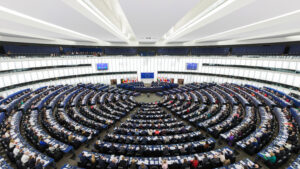
MEPs pushed through their objections against Slovakia (by 418 votes in favour, 207 against and 14 abstentions) during the vote on the discharge for last year’s EU budget.
This discharge is normally voted on every year. “Even before the vote, the budgetary committee adopted important amendments to it, in which MEPs called on the European Commission to trigger the conditionality mechanism against Slovakia,” explained Marián Koreň, an analyst at the euBrief website.
Slovak president Peter Pellegrini sees the parliament’s call to freeze EU funds as a politically motivated move against Slovakia. He claims MEPs want to punish Slovakia for some of the positions taken by Fico’s government.
“I firmly believe that, in the end, such a vote will not be successful and that the European Union will not freeze EU funds for us,” wrote Pellegrini in a statement.
In his view, these are merely outbursts by politicians who have their own opinions about Slovakia. “As president, I cannot wish for such a calamity; on the contrary, I firmly believe and hope that this will not actually happen and that it is just political scaremongering,” he added in the statement.
Conditionality mechanism
The rule-of-law conditionality regulation serves to protect the EU budget.
It was created for cases where an EU member state fails to properly investigate corruption or undermines the independence of the courts, meaning it is unable to adequately protect EU money from misuse.
The initiative to freeze EU funds was launched by the European Commission, which has a key role in analysing the situation. If the commission proposes to stop payments, the Council of the EU, representing member states, must vote on this proposal within one month at the latest, by qualified majority.
“For this step, a solid compromise took hold among MEPs across the political spectrum – from conservatives to the left,” said Daniel Freund, a German Green MEP who sits on the European Parliament’s budgetary control committee.
Speaking to Denník N, Freund said there are parallels between Fico, Orbán and Jarosław Kaczyński, a Polish conservative whose twin brother held similar views before passing away in 2010.
Freund has long been active on rule-of-law issues and led similar procedures against Hungary and Poland. In the budgetary control committee, he serves as coordinator.
“The aim of the European Parliament in this case is to avoid the Hungarian scenario, where it took more than ten years before the EU actually stepped in,” Freund said. In Slovakia’s case, MEPs are sending early warning signals to prevent the destruction of democracy and the rule of law, since developments are moving far too fast, says Freund.
This approach was already evident when interior minister Matúš Šutaj Eštok tried to abolish the whistleblower protection office. The new legislation had already triggered concerns in Brussels even during its adoption phase. Nevertheless, Fico’s government approved the law abolishing the office, only to later to re-introduce it given EU threats to freeze funds.
Freund says Fico would now “have to think twice” about whether he wants to follow Orbán’s practices. “The Slovak prime minister should assess whether this confrontational approach paid off for Orbán at all,” Freund said.
The Slovak opposition did not join in
The MEPs from Progressive Slovakia and the Christian Democratic Movement had already announced in advance that they would either vote against or abstain.
“I realise that if Slovakia were deprived of EU funds, the economic situation of citizens would drastically worsen. I certainly do not want people to suffer because of whom they elected to lead the country,” said Miriam Lexmann, a Slovak MEP with centre-right European People’s Party. At the same time, she said, the key to whether Slovakia loses EU funds or not lies in the hands of Fico’s government.
“That government bears full responsibility for the trust of the European Union and access to European resources,” she added.
Progressive Slovakia took a similar position on the vote, announcing in advance that it would not take part. “We are protecting EU funds for Slovakia, but we cannot cover up Fico’s thefts,” the party wrote in a statement on Instagram.
“Respect for the principles of the rule of law, the protection of public resources and helping people are core values for me and for PS. Unfortunately, in Slovak conditions we cannot do without European money, because up to 80 percent of public investment that goes into roads, schools or to farmers comes from the EU. Without EU funds, Slovakia would fall to its knees, no matter which government is in power,” said Lucia Yar, a Slovak MEP with liberal Renew Europe.
What happens next
The official report of the European Parliament’s budgetary control committee criticised Slovakia for controversial amendments to the Criminal Code in 2024, which abolishes the Office of the Special Prosecutor and the National Criminal Agency. The report says these steps led to “delays in investigations” and to a significant decline in the number of corruption cases.
All of this, according to MEPs, constitutes “an increased and significant risk to the sound financial management of the Union budget”.
Wednesday’s vote does not automatically mean Slovakia will lose EU funds. First, the commission would have to agree. “The European Commission does not have to heed the parliament’s call immediately, but if it decided to trigger the mechanism, it would be a longer process, lasting roughly six months to a year,” euBrief’s analyst Koreň explained.
It is assumed any impact would likely only be felt end of next year should the commission act quickly.
The commission would first have to spell out its objections to Slovakia in detail and justify why it wanted to trigger the mechanism. Bratislava would then have around two months to respond. And in the final stage, the member states would vote by qualified majority on freezing EU funds.
The Hungarian precedent
Hungary was the first and so far only EU country to have its EU funds frozen by this same procedure, in 2022, with the process taking longer. But the slow pace of the Hungarian procedure has caused frustration. A different approach is expected in Slovakia’s case.
In Hungary too, the main problem was persistent concerns about corruption, which meant that European taxpayers’ money was not going where it was supposed to. The market reaction to the freezing of funds was very swift. On the day of the announcement, the Hungarian BUX index fell by 3.55 percent, and the Hungarian forint also weakened.
In total, it was a sum of roughly €22bn from cohesion resources. Of this amount, the European Commission eventually released €10.2bn at the end of 2023, when Hungary had, in its view, fulfilled reforms in the area of the judiciary.
The parliament, however, accused the commission of succumbing to pressure from Orbán, who had been blocking EU aid to Ukraine. MEPs insisted that the government in Budapest still did not meet rule-of-law conditions.
Unblocking EU funds has been set as one of the priorities of the future Hungarian prime minister and winner of the recent parliamentary elections, Péter Magyar. He was therefore due to meet European commission president Ursula von der Leyen on Wednesday.
Magyar’s approach, according to Politico, has a certain degree of political support in Brussels. The meeting with Von der Leyen, it said, “sends a signal” of goodwill towards the new Hungarian leader, who is promising an end to the politics of Orbán’s 16-year long era.
According to a source quoted by the website, the aim of the meeting is to inform Brussels about activities already under way and to identify the most important objectives, so that he can achieve the fastest possible way of drawing down financial resources.
“Magyar wants to prioritise reforms and goals that can be implemented before the deadline expires, while slower constitutional changes, in connection with which Tisza has promised consultations with stakeholders and the public, will be postponed until later,” reported Politico.