
The EU’s enlargement criteria have long prioritised economic reform, rule of law and anti-corruption over social protection measures. A new study looks at what this means in practice for the western Balkans — and what needs to change.
 The Friedrich Ebert Foundation



The EU’s enlargement criteria have long prioritised economic reform, rule of law and anti-corruption over social protection measures.
A new report by the Friedrich-Ebert-Stiftung asks what this means in practice for the western Balkans, and what needs to change.
EU enlargement in the western Balkan region is picking up speed. Last Wednesday (22 April) the European Commission announced it will start drafting an accession treaty for Montenegro, making it the first time since Croatia joined the bloc in 2013 that the EU has initiated such a process.
The study, first presented at the conference An Enlargement for a New Generation, examines the social dimension of the EU’s enlargement frameworks for all six candidate countries from the western Balkans: Albania, Bosnia and Herzegovina, Kosovo, North Macedonia, Montenegro and Serbia.
Analysing reform commitments made through economic reform programmes and reform agendas between 2022 and 2025.
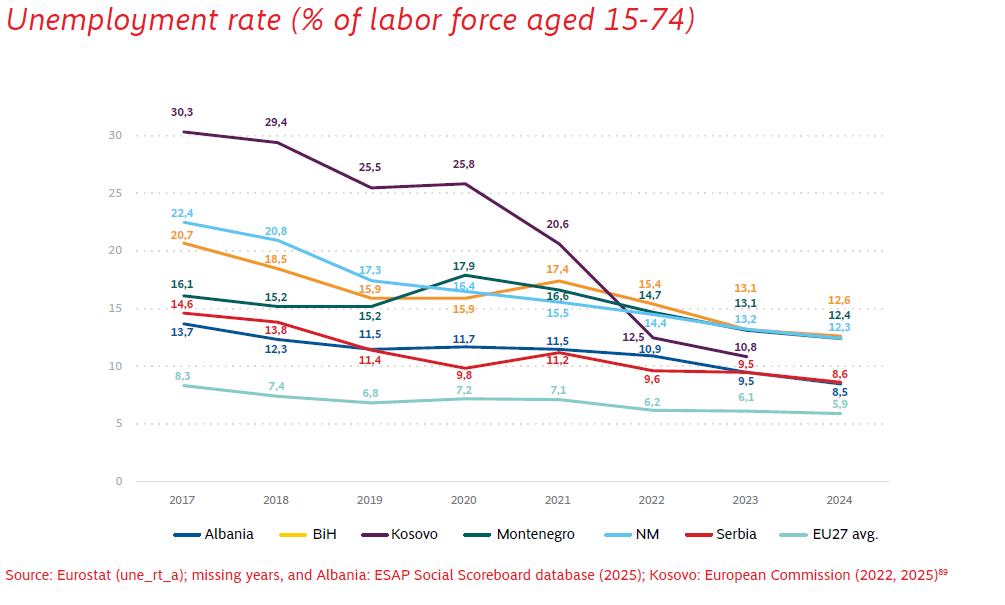
The report concludes that despite falling unemployment, the region is still facing longstanding structural social challenges.
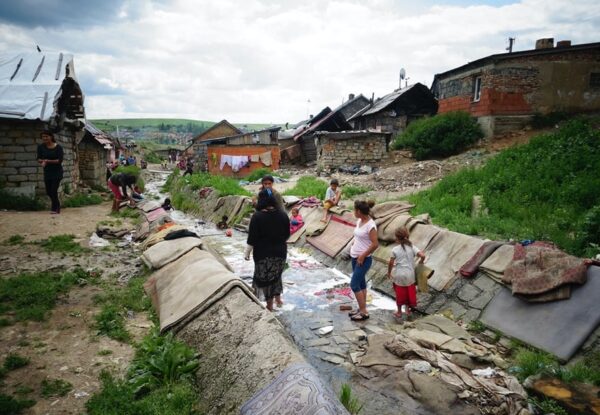
Dr Mirna Jusić, author of the study, points out that the labour markets in the region still grapple with systemic difficulties, despite increased employment rates: “We still see high youth and long-term unemployment, as well as high levels of informal work. Also the gender employment gap is still pervasive, there are low activity rates among women in most countries, especially in Kosovo and Bosnia, and there are barriers to access the labour market for various groups such as Roma, persons with disabilities etc.”
Also education and healthcare remain sore areas. “Quite high numbers of students do not achieve functional literacy on the PISA test, in the areas of maths, science and reading,” Jusić says.
“Healthcare remains underdeveloped, with out-of-pocket healthcare costs in the region remaining far higher than the EU average,” she continues. “For most countries there is still an absence of policy reforms pertaining to affordable and quality healthcare.”
“Social policies are not sufficiently effective to tackle poverty,” Jusić explains. The countries have high rates of people at risk of poverty, high social exclusion rates, and high levels of income inequality. “What is striking also is that the impact of social transfers on poverty are much lower than in the European Union.”
Reform agendas
The EU has long used Economic Reform Programmes (ERP), annual reform plans agreed with Brussels, to shape policy in the region.
Since 2024, these have been supplemented by Reform Agendas (RA) linked to the new €6bn Reform and Growth Facility, which pays out only when reforms are completed.
One of the problems with the ERPs is the gap between promised reforms and actual implementation – something the new RAs look to resolve.
“In the case of the RAs funding only comes in if the implementation is actually carried out,” Jusić explains.
However, with the migration of structural reforms from ERPs to RAs, the study observed the reform commitments becoming narrower. Jusić points to a time constraint when the RA’s were being developed: “They were prepared quite quickly, and a lot had to be negotiated between the Commission and the countries.”
The result is that quite a few of the measures that were included in the ERPs were not transferred to the RAs. Specifically social protection reforms seem to have gone missing.
“Some countries haven’t even included social protection reforms in their reform agendas,” Jusić explains. “The only countries that have explicit social protection measures under the human capital chapter are Bosnia and Montenegro. The others have decided to focus on employment and education related measures.”
Outputs instead of outcomes
Since the EU’s funding is conditional on the fulfilment of reforms, it is not surprising that the benchmarks introduced by countries tend to be formulated as outputs, as activities to be completed, rather than outcomes.
This has invited short-termism, the study finds.
It is easier to introduce measures on digital infrastructure in education, which is something that can be easily acted upon and evaluated, than to commit to systemic reforms that could help countries build educational systems that foster functional literacy.
Another reason for the absence of social reforms is the excessive focus on available capacity, according to Jusić.
“This idea of having or not having sufficient capacity is often used in discourse surrounding reforms in the Balkans,” she says. “If you are going to have to show progress quite quickly, you want to implement something for which you know you will have capacity.”
While this is an important consideration, capacity building efforts should take place in parallel to social reforms, Jusić argues. “We cannot wait for capacities to be built before granting people social rights. Capacity has to be progressively built, and the EU has quite a few tools to help countries do this.”
“The previous ERPs also included something called the social scoreboard, for all the Western Balkans countries,” Jusić says. The social scoreboard is the monitoring tool used to track countries’ progress against the European Pillar of Social Rights (EPSR).
“In their annual assessment, the European Commission would look at how each country is faring against the social scoreboard,” she continues. This was quietly dropped from the agendas, and countries’ social convergence with the EU is no longer monitored in line with the EU’s indicators.
Including social dimension is crucial
Among the six recommendations the study develops, Jusić considers this as perhaps the most urgent change to be made: “First of all, the social scoreboard needs to find its way back into the economic governance process.”
Outputs should be linked to broader social outcomes, as monitored by the social scoreboard. This in turn might compel the countries to place a stronger focus on social measures.
Another method would be to front-load the social negotiating chapters in the accession talks.
Currently Albania and Montenegro are closest to EU accession, and they are the only two that have started negotiations on the social chapters.

“The social rights are fundamental rights, and they are not being prioritised, they are in clusters two and three of the negotiation process. So the idea here would be to try to front-load these,” Jusić explains.
This way the other countries can also pick up pace on social reforms, rather than wait around to tackle crucial social protection measures that will end up being on the agenda anyway.
The region’s sluggish social convergence with the EU calls for more than technical adjustments.
The social dimension of enlargement remains limited, offering little incentive for governments to secure a broader range of social rights.
Addressing deep-rooted social challenges in the western Balkans, Jusić concludes in her study, requires a more comprehensive approach.
Ultimately, the success of the EU’s social agenda will depend on whether reforms resonate with local priorities; without this alignment, scepticism in the region towards enlargement will persist.
This stakeholder article is paid for by a third party. All opinions in this article reflect the views of the author and not of EUobserver.