
Barbed wire, ‘dragon’s teeth’, ditch, berm, more wire, ditch, embankment, wire, third ditch: Ukrainian fortifications claiming 1,000 Russian soldiers a month.
 Tomáš Vasilko



Every day, the Ukraine Battlefield update newsletter offers a clear look at how the war is unfolding on the ground, highlighting key developments along the frontline and the shifting dynamics of the conflict.
Defensive fortifications are completely different from those at the start of the war, a Ukrainian general said. Ukrainians eliminate 1,000 Russian soldiers on them every month. Kyiv wants to protect roads up to 100 km from the front with anti-drone nets. Burning oil was flowing through the streets in Tuapse. Maps of the day: the battle for Rodynske and an important village near Huliaipole. Videos of the day: a Russian drone knocks but does not explode; another Ukrainian strike 1,600 km from the front.
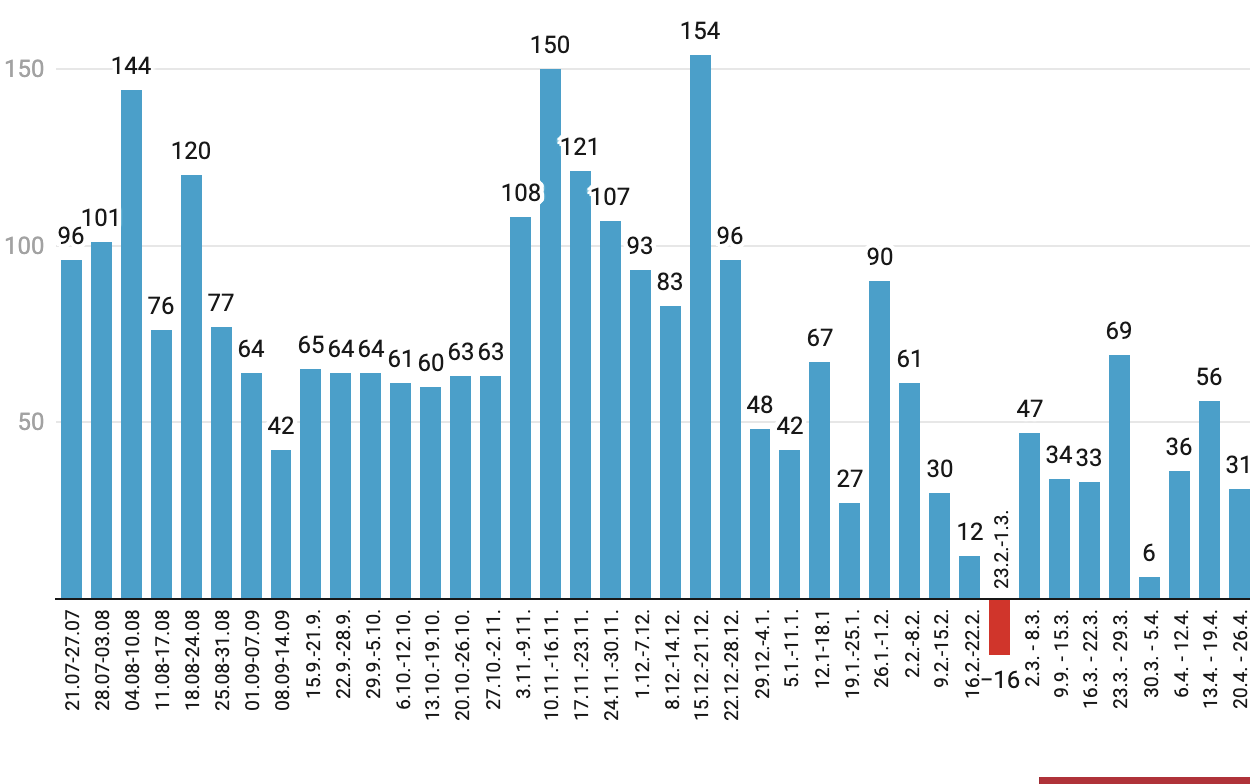
Well-constructed fortifications are one of the reasons why the Russians have been doing so poorly this year. As we also show in the chart of the day, their advance has slowed significantly and their spring-summer offensive has not really taken off so far.
As Ukrainian journalist David Kirichenko recently wrote, Ukraine has invested substantial resources in improving its system of fortifications.
“If we had had such defensive lines back in 2022, the situation on the battlefield would be the complete opposite of what it is now,” Viacheslav Shutenko, commander of a drone battalion that is part of the 44th Mechanised Brigade, also said to The Economist at the beginning of the year.
The role of fortifications during the war has not been discussed as much as it deserves. General Vasyl Sirotenko, commander of the engineering units of the Ukrainian armed forces, decided to change that when he spoke about them at a conference on engineering troops and logistics. Naturally, as a proper commander he tried to present the role of his units in the war in the best possible light, but his words were also confirmed by other sources.
As he said, the role of fortifications had changed significantly since 2022 and was continuing to evolve. “Perhaps only the name ‘defensive line’ has remained,” he said, according to the Ukrainian agency Ukrinform.
“The emphasis is placed more on exhausting and disrupting enemy forces than on strictly territorial defence,” David Kirichenko wrote.
Let us now go through a typical defensive line. The Economist, for example, described the one near Sloviansk. First comes barbed wire intended to slow down infantry. This is followed by concrete pyramids known as dragon’s teeth, designed to slow armoured vehicles, and then an anti-tank ditch 2 m deep and 3 m wide. Next is a berm made from the excavated soil.
“Then comes another wire, a second anti-tank ditch and an embankment, and then another belt of wire. In some places there is a third ditch, dragon’s teeth (concrete anti-tank obstacles) and mines,” The Economist wrote.
An entire line of this kind is about 200 m wide. Individual lines are often located from each other at mortar range, which can be several kms, according to journalist Kirichenko. “This allows Ukrainian units to trade space for time and launch counterattacks against exposed enemy assault groups before they have time to regroup,” he wrote.
Russian soldiers on motorbikes or on foot would be able to make their way through these obstacles, but it would take them a long time, which gives drone operators an opportunity to eliminate them.
Exactly that is what is happening. The general claimed that such fortifications were currently causing Russian troops the most damage after unmanned systems, which were responsible for the overwhelming majority of Russian losses.
The general said that on average this meant a thousand Russian soldiers a month (out of roughly 30,000 Russian casualties). These are soldiers whose attack ends on these fortifications: either they are hit by mines, or by Ukrainian drone operators.
“For example, in March 2026, 663 occupation soldiers, 95 pieces of weaponry and military equipment and three other targets were eliminated at engineering obstacles built by all engineering units of the Ukrainian defence forces,” general Sirotenko said, according to Ukrinform.
The structures intended to protect soldiers have also changed. After 2015, Ukrainians began building huge defensive positions in Donbas. They were large; the general spoke of entire fortified areas. “The plan was for there to be a significant number of weapons here – from artillery and mortars to air-defence assets,” he said.
However, such large fortified areas are currently ineffective. The concentration of a large amount of equipment or soldiers would be a lure for the enemy.
That is why smaller fortifications are now being built, which, according to Sirotenko, must be inconspicuous.
Since 2024 and 2025, these trenches have also been covered from above. “Today, no one even talks any more about covering trenches – it is taken for granted when building such fortifications. Defensive structures and the passages between them are also covered,” the general said, adding that the more Russian drones fly over an area, the deeper Ukrainians have to dig in.
Ukrainians are constantly building new fortifications. Here are new ones built since 8 April, according to the Playfra account
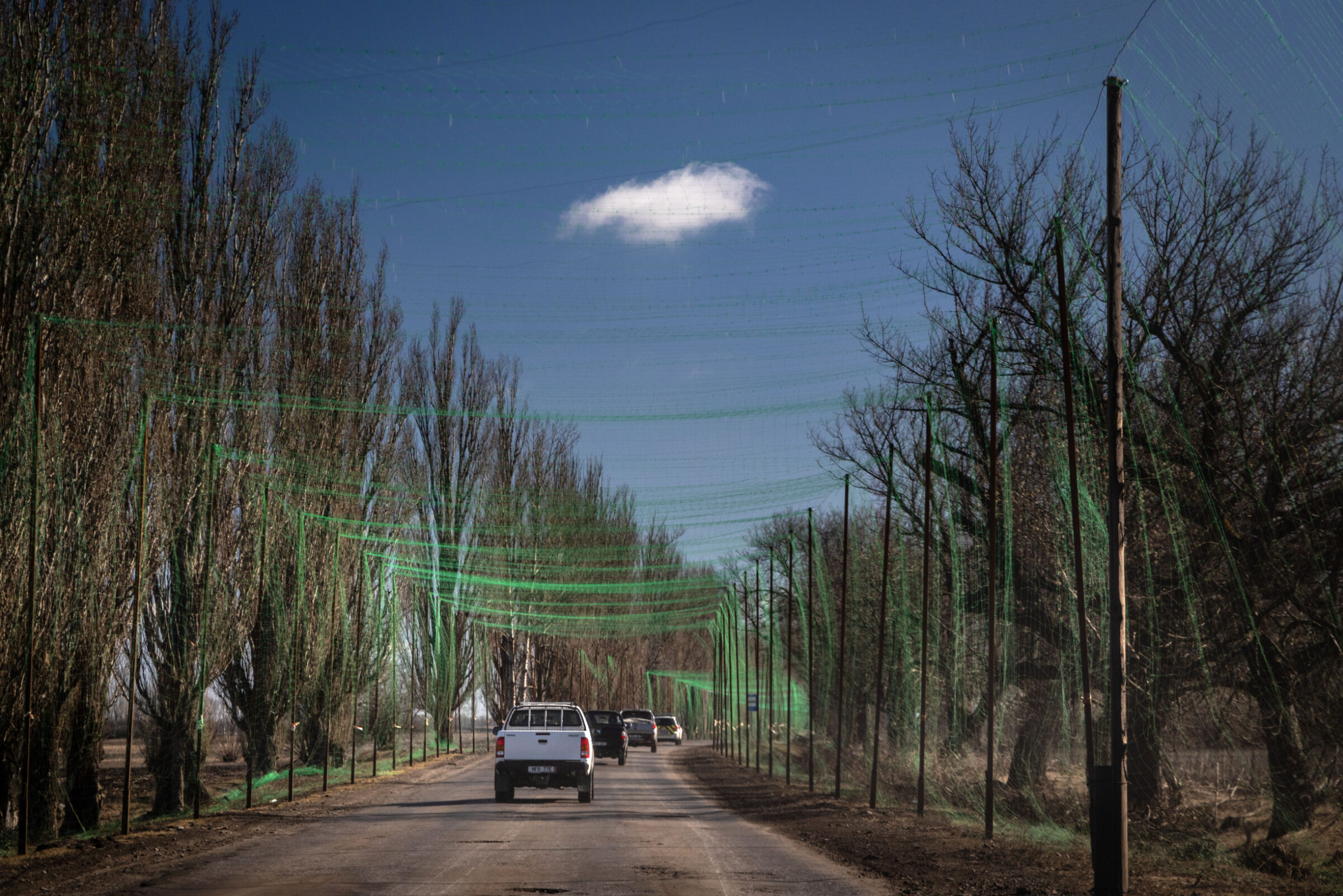
The task of the engineering units also includes building protective nets. According to the general, the Russians are able to hit Ukrainian positions with smaller drones even 40 to 50 km behind the front line. For this reason, Ukrainians are building anti-drone nets not only near the front, but also in more distant towns. Roads are protected against drones in this way, as are streets in cities such as Kherson or Kramatorsk. As Denník N reporters saw in March, in Donbas they are already almost everywhere, covering even the road between Izium and Kharkiv.
Sirotenko claimed that thousands of kms of roads were already covered in this way. According to him, the aim was to cover the area up to 100 km from the front. This would mean it would also apply to the city of Pavlohrad and, in time, possibly even the million-strong Dnipro.
Sirotenko agreed that the net would not prevent a drone from exploding. “There is no net that would contain the explosion of a drone. However, the design of the nets is such that even if the explosive or the device carried by the drone is activated, the distances minimise the impact of fragments and the deviation of the projectile. This means it no longer hits the equipment but veers off to the other side, which significantly increases the chances of personnel survival,” the general said.
He also hinted at where developments could go next. He spoke about automating fortifications using artificial intelligence. However, he did not elaborate on what exactly that should mean.
“Such systems are our future, and not some distant one; they are already being introduced today,” he added.
Residents of the Russian city of Tuapse are experiencing situations they could not even have imagined until recently. After previously seeing rain mixed with burnt oil falling on them, this time they witnessed burning oil in the city streets. It spilled from tanks at the refinery that was targeted by Ukrainian drones on Tuesday. It was the third attack in two weeks.
Flaming crude oil from Russia’s Tuapse Oil Refinery is spilling into nearby city streets.
The refinery, hit by Ukrainian drones overnight, continues to burn out of control. pic.twitter.com/bDPu0moJCH
— OSINTtechnical (@Osinttechnical) April 28, 2026
Other videos showed oil being removed from the sea and the shoreline.
The minister for emergency situations, Alexander Kurenkov, came to the city this time as well. On Wednesday morning he stated that the leakage of oil into the streets had been stopped. He described the situation as “difficult but under control”. The main goal was to extinguish the fire, which was visible even from the top of Krasnaya Polyana near Sochi (the Olympic Games were held there in 2014), and to remove the oil from the coastline.
A massive plume of smoke from the burning oil refinery in Tuapse is visible from the Krasnaya Polyana mountain resort, located 105 km away. A state of emergency has been declared throughout the entire Tuapse district. pic.twitter.com/QZRDa0Newb
— WarTranslated (@wartranslated) April 28, 2026
Russian president Vladimir Putin also commented on Tuapse for the first time. “Drone attacks on civilian infrastructure are becoming more frequent. The latest example is the attacks on energy facilities in Tuapse, which could have serious environmental consequences. However, the governor has just reported that there do not appear to be any serious threats; people are dealing with the challenges they face directly on the ground,” he said.
Tuesday’s attack itself may not have caused as much damage as the previous ones, which, according to OSINT analysts, destroyed 24 oil tanks. As the Ukrainian account KiberBorošno wrote, one of the tanks burned out completely, but the fire did not spread to the neighbouring ones. In addition, a gantry at the refinery (not a tank) was burning, and the fire probably spread to the river as a result of the leak.
Maps of the day
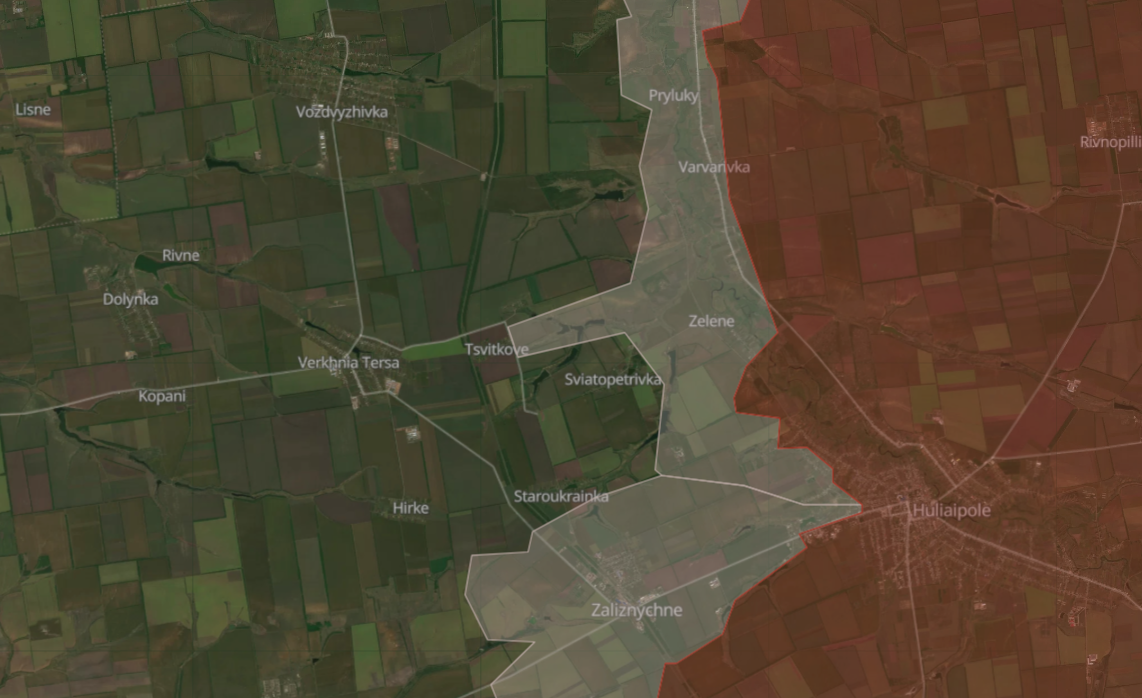
We have not written about the Huliaipole axis for some time, but it still remains a place where the Russians carry out the second highest number of attacks after the Dobropillia axis. As Ukrainian military analyst Bohdan Myroshnykov wrote, the Russians have launched active operations near the village of Verkhniya Tersa.
First, they shelled it with artillery and drones, but they have already started sending infiltration groups into this village as well. According to him, they have not managed to hold the village, but they are not stopping their attempts. “On our side, everything possible is being done to ensure that the occupiers are not there,” he wrote.
The village is located about 11 km west of the town of Huliaipole and 8 km from the nearest Russian-held positions, according to maps by DeepState UA and Black Bird Group.
According to Myroshnykov, it is important because it is a junction of key secondary roads to Orikhiv and Ternuvate. He therefore expects the fighting for this village to continue.
Source – Deepstate UA
A Ukrainian soldier who goes by the nickname Officer described the situation in the small town of Rodynske. It is located northwest of Myrnohrad and is currently slowing the Russian advance towards Dobropillia.
According to him, the Russians are actively pushing in here; there are constant enemy infiltrations. “So far, however, they have not managed to capture it.”
“Rodynske itself is turning into a huge mass grave for them under the rubble of high-rise buildings and houses in the suburban districts with detached homes. The casualty ratio in this area has long since exceeded 1:10. Plus countless unidentified bodies under the rubble, which even they will never dig out,” Officer wrote.
Source – DeepState UA/Officer
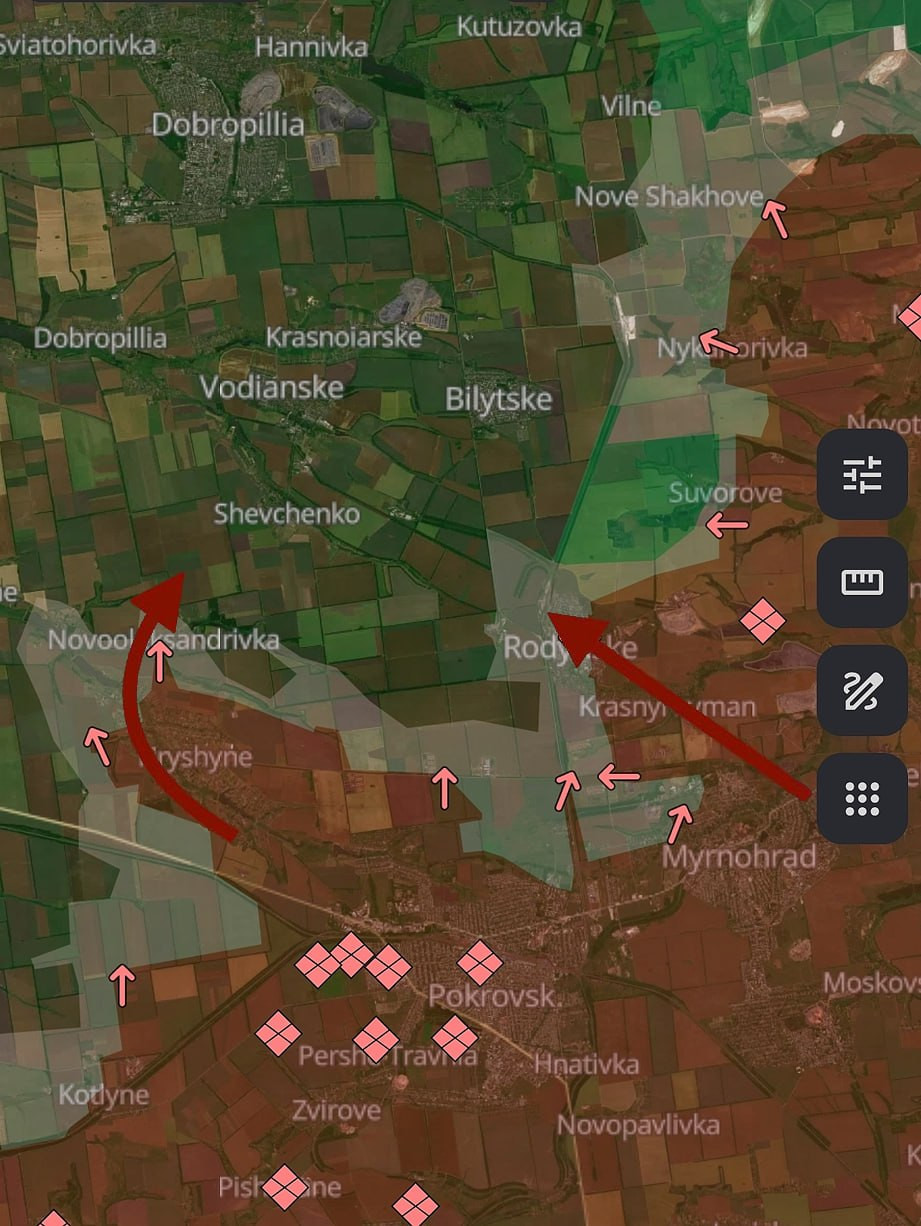
Chart of the day
Over the past week, the Russian army advanced by 31 square kms in Ukraine, returning to the average of the last three months. According to DeepState UA, they moved forward the most near Kupiansk and Huliaipole. Overall, this is significantly less than their gains in the second half of last year. At this pace, it would take them 14 years just to capture the rest of Donetsk region. Of course, this could change.
Russian advance by weeks
Amount of territory occupied by Russians per week. Data is in square kilometers.
Videos of the day
Footage of a fire also arrived on Wednesday morning from an oil and gas terminal in the Russian city of Perm. It is a pumping station that distributes raw materials into pipelines. Perm is located 1,600 km from the Ukrainian border.
It is reported that Russia’s Perm Oil and Gas Terminal is on fire.
This is a nodal station of the Transneft system, responsible for pumping, storing and distributing oil through main pipelines. pic.twitter.com/Td0A4sGM37
— Anton Gerashchenko (@Gerashchenko_en) April 29, 2026
A Russian drone tried to hit a modern American M1083 military truck in the service of the Ukrainian army. Instead, it merely knocked on it and did not explode.
If you ever feel useless, just remember this ruSSian FPV drone knocking on this Ukrainian FMTV M1083 truck. pic.twitter.com/JtU7cgMjxY
— 𝔗𝔥𝔢 𝕯𝔢𝔞𝔡 𝕯𝔦𝔰𝔱𝔯𝔦𝔠𝔱△ 🇬🇪🇺🇦🇺🇲🇬🇷 (@TheDeadDistrict) April 28, 2026
What the losses are
On Wednesday morning, without an update.
By Monday morning, Russia had demonstrably lost 24,487 pieces of heavy equipment (on Tuesday (21 April) it was 24,471). Of these, 19,123 (19,108) pieces were destroyed by Ukrainians, 976 (976) were damaged, 1,206 (1,206) were abandoned by their crews and 3,182 (3,181) were captured by the Ukrainian army. This includes 4,389 (4,385) tanks, of which 3,292 (3,288) were destroyed in combat. Ukraine lost 12,050 (11,977) pieces of equipment, of which 9,272 (9,224) were destroyed, 673 (669) damaged, 671 (670) abandoned and 1,414 (1,414) captured. This includes 1,419 (1,416) tanks, of which 1,084 (1,081) were destroyed in combat.
Note: Neither side regularly reports its dead or destroyed equipment. Ukraine publishes daily figures for Russian casualties and destroyed equipment, which cannot be independently verified. In this overview we use data from the Oryx project which, since the beginning of the war, has compiled a list exclusively of visually documented equipment losses.