
Former diplomat Ian Bancroft explains how his new book explores the dysfunctional state that Bosnia and Herzegovina is in – and its people’s deep desire for a way out.
 Ian Bancroft



A regularly heard concern is the profound demographic crisis. Many young people and their families have left, likely never to return. The population is rapidly aging. Whilst diaspora ties bring new hope and possibility, they cannot substitute for those living and breathing Bosnia and Herzegovina daily. Though some speak encouragingly about the country’s economy, its pace of growth remains insufficient.
And yet, contained within these pages, is a glimmer of hope. The book, contrary to the expectations of some, offers refreshing perspectives on the daily lives of people across Bosnia and Herzegovina. Whilst not ignoring the uncertainty and despair that many continue to endure, there is also an energy and innovativeness that is often ignored. This is especially true at the local level; whether the boring peace of Bosanski Petrovac, the unrealised potential of Brcko District, or the experiences of other communities throughout the country.
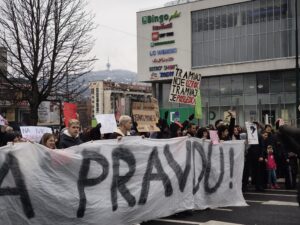
New movements have arisen, primarily focused on environmental issues. Whether opposing small-scale hydroelectric plants on the river Neretva, or mining projects in Ozren and elsewhere, they unite people from a variety of backgrounds. There is a renewed appreciation for the country’s immense natural wealth and beauty, and how it needs to be safeguarded for the sake of future generations.
Young people are finding new ways to confront the war and oppose manufactured divisions. Whilst schoolchildren in Jajce have stood up against segregation of education, an informal group of activists are marking sites of suffering throughout the country. They are holding up a mirror to their own communities, asking them to reflect upon how they are dealing with the legacies of the war. Though the results will not be immediate, the important questions are finally being asked.
A new generation of artists, musicians, writers, and others is endeavouring to harness the country’s past to unlock the future. Some challenge the war – its militarisation, nationalism, and suffering – head on, whilst others deliver into Bosnia and Herzegovina’s treasure trove of history to create contemporary manifestations. They are shaping the post-Yugoslav space and challenging the narratives that seek to determine the identity of the country’s people.
One unifying thread that runs through the book is an appreciation for the peace that had reigned for these 30 years. It is neither taken for granted nor undervalued. Whilst often defined in negative terms – namely, as an absence of violence – it has nonetheless provided the foundations on which a better tomorrow can be built. It is a timely reminder that regardless of all the divisive rhetoric and pessimistic portrayals, Bosnia and Herzegovina has avoided a return to war.
Whilst the notion of a civic narrative for Bosnia and Herzegovina remains a distant dream, these new mobilisations and forms of expression contribute to a society that is more resilient and resistant to destabilising forces. They demonstrate a creativity and resolve that can drive change in various aspects of life, even whilst the domain of politics remains immune to reform. It is not a sign of impending revolution but of a positive evolution.
These testimonies of different voices from across the country – individuals whose voices are regularly sidelined – provide a vivid mosaic of where Bosnia and Herzegovina stands today and where it is headed tomorrow. It is an essential portrait of resilience and the search for a path forward, with profound examples of those fighting against or within this straitjacket. There is a feeling of helplessness but not hopelessness. The question now is how such sentiments will sound in 20 or 30 years’ time.
Ian Bancroft is a writer and former diplomat based in the region. In addition to ‘The Bosnian Straitjacket,’ he is the author of a novel, ‘Luka’, inspired by Bosnia and Herzegovina, and ‘Dragon’s Teeth – Tales from North Kosovo’.
The opinions expressed are those of the author and do not necessarily reflect the views of BIRN.