

Plucky campaigners from a small, rural community proved to be no match for a giant of industrial poultry production.
 Nebojsa Milicevic



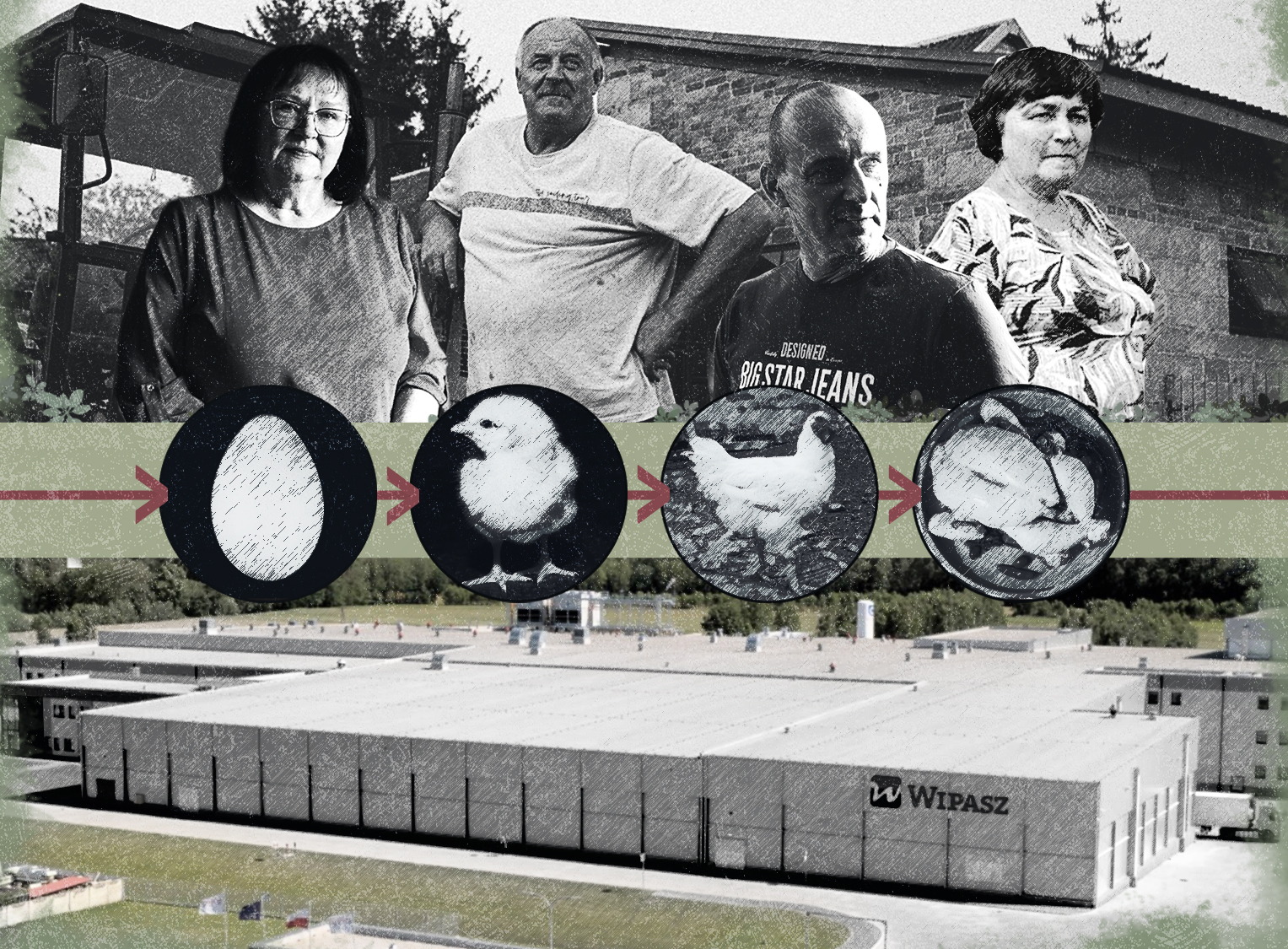
“It’s a fucking disaster,” said Dariusz Mackiewicz, a railway employee and farmer who helped spearhead the local campaign against the industry. “People tell us: you lost.” A well-built, restless man with close-cropped hair, he seems visibly fatigued as he sits in his kitchen, recalling the recent years of fruitless struggle. A cupboard full of medals and cups attests to his past as a Nordic walking champion. As a youngster, he travelled around, ending up as far as Miami. But when he wanted to settle down and start a family, it was to Koden that he returned, a municipality of around 3,000 people nestled in a bend of the Bug river. This is not a particularly prosperous part of the country. Much of the farmland is of poor quality, good enough for smallholdings and the occasional agro-tourism venture, little else. Glimpsed from the road, the landscape may be nothing spectacular – fields, woodland, waterways and more fields – but it is undeniably pretty. Poland stops here. Any further east and you would be in Belarus.
For the last couple of years, two vast poultry production facilities – calling them chicken farms is like calling a super-tanker a boat – have been operating on the northern outskirts of Koden village. Both sites combined have a fenced area larger than 15 football pitches, covered in 26 low-rise barns stretching as far as the eye can see. Together, they can produce around 14 million birds for slaughter annually, or more than 4,000 chickens for every human in Koden. The megafarms have altered the character of the village. Now, dozens of trucks traverse the village roads every month, cracking the tarmac and sending tremors through homes. The damage to the social fabric is no less dramatic. Koden today is a community sharply divided, with supporters of the farms barely speaking to those who have opposed them. Stories circulate about old friends, even family members, cutting ties over the dispute. Local council meetings are tense, often dissolving into shouting matches. Whatever Koden had once been, it is a very different place now.
Barbara Bil, a youthful grandmother, owns a quaint farmhouse with a plot of land in the north of Koden village. Her youngest son had planned to build a new house there with a cluster of cottages, a family retreat for his eight siblings. The plan was ditched after the new poultry facility took shape, with vast barns housing millions of chickens barely 300 metres away. “The stench can be absolutely unbearable,” Bil told me. “On some days, I come here and have to leave immediately.” On the afternoon that I visited the farm with the photographer, I felt like doing the same. The heavy sweet-sour odour, reminiscent of rotting meat, clung to the nostrils.
The impact of intensive, large-scale poultry farming is, campaigners say, comparable to that of a large factory. Industrial chicken farming uses vast amounts of water and generates tonnes of manure, which can harm the soil and waterways. “If we look at the impact of this sector on the climate, the environment, bio-diversity, water, air and consumer rights, and on the quality of life of those living near these so-called farms, we would all have to agree that this is industry, heavy industry,” said Sylwia Spurek, a former member of the European Parliament who has pushed for tighter scrutiny of industrial meat production.