



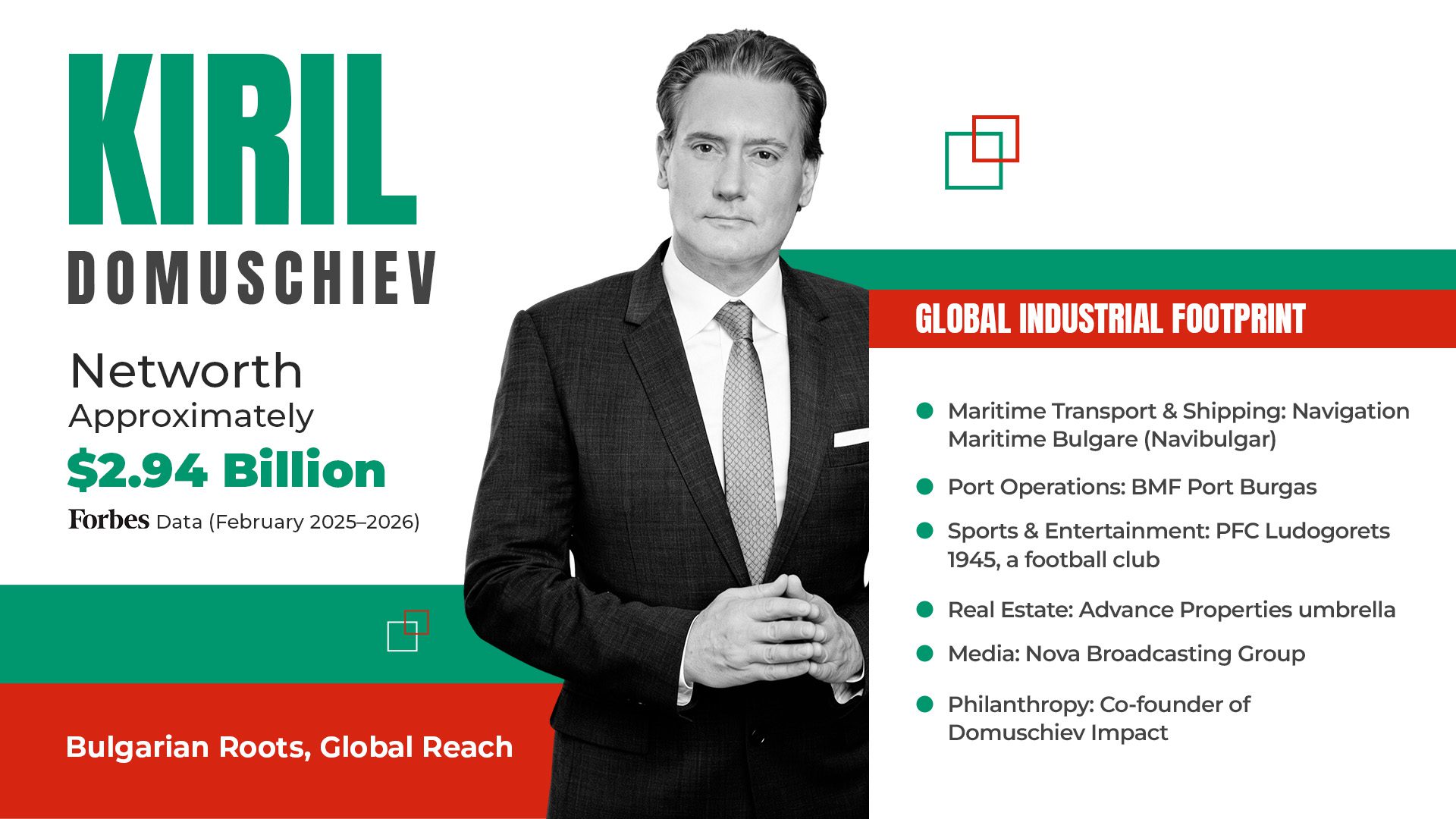
If you walk along the Danube River in the city of Rousse, you might see huge cargo ships passing by. Decades ago, a young man named Kiril Domuschiev looked at those ships and saw opportunity. But he didn’t start with ships. He started with medicine.
Today, Kiril Domuschiev is one of the richest and most influential people in Bulgaria. But calling him just a “businessman” doesn’t quite cover it. He is a builder. He is a perfect example of what we call a Balkan conglomerate case study. He didn’t just build one successful company; he built an empire that touches everything from the antibiotics your pet might take to the massive ships carrying grain across the Atlantic.
His story is inspiring because it shows that you don’t have to stay in one lane. If you have the vision and the guts, you can master multiple industries at the same time.
The Beginning: The Pharmacist of the Danube
Kiril Domuschiev was born in 1969 in Rousse, Bulgaria. In the 1990s, after the fall of communism, Bulgaria was a wild place. The old state-owned companies were being sold off, and the economy was unpredictable.
While many people were confused or scared, Kiril and his brother Georgi saw a puzzle that needed solving. They got their start in the Southeast European pharma industry. They weren’t doctors or chemists; they were entrepreneurs.
In 1994, they founded Huvepharma.
- The Challenge: The pharmaceutical industry is hard. It requires strict rules, expensive equipment, and years of trust.
- The Move: They didn’t just open a small pharmacy. They went big. They focused on producing Active Pharmaceutical Ingredients (APIs). They specialized in animal health, making medicines and vitamins for livestock.
This was a smart move. The world was starting to consume more meat, which meant farmers needed more medicine for their animals. Huvepharma grew rapidly. They bought old factories, fixed them up, and brought them up to global standards. Today, Huvepharma is a global leader in animal health, exporting to over 100 countries. It is the bedrock of Kiril’s fortune.
The Massive Leap: Why Enter the Shipping Business?
Most people, if they had a booming pharma company, would just relax. They would enjoy the profit. But Kiril Domuschiev is not “most people.”
He looked at the map of Bulgaria. He saw the Black Sea. He saw the Danube. He realized that Bulgaria was a bridge between East and West. He decided to enter the shipping industry. This is a completely different world from pills and powders. Shipping is about steel, fuel, and global trade.
In 2014, he established Navigation Maritime Bulga (NMB).
- The Risk: Shipping is notoriously volatile. One day, rates are high, and you are a millionaire. The next day, they crash.
- The Commitment: Despite the risk, he went all in. He bought ship after ship. At one point, NMB was the largest dry bulk shipping company in the world by number of vessels.
This move transformed him from a major Bulgarian business leader into a global player. He now controlled the flow of goods, coal, grain, and iron ore across the world’s oceans. It was a stunning expansion that proved his business model wasn’t a fluke. It was a system.
The Power of a Conglomerate
What makes Kiril Domuschiev such an interesting Balkan conglomerate case study is that he didn’t just accumulate assets randomly. He built a portfolio that works together.
Think about it:
Huvepharma deals with chemical products.
NMB (Shipping) deals with logistics and transport.
Chemicals need ships to be moved. While his companies operate independently, the mindset required to run them is similar: efficiency, scale, and global reach. He creates a synergy of skills. He understands logistics, compliance, and scale better than almost anyone else in the region.
The Human Element: Family and Sports
Behind every great businessman is a story of people. Kiril didn’t do this alone. His brother, Georgi Domuschiev, has been his partner from day one. In the volatile world of Eastern European business, having a partner you can trust is worth more than gold. They balanced each other out and shared the burden of risk.
But Kiril is also famous for his passion outside the boardroom. He is a passionate football fan. In 2015, he became the owner of CSKA Sofia, one of the most legendary football clubs in Bulgaria.
Investment: He poured money into the stadium and the team.
Revival: He helped bring the club back from the brink of financial ruin and onto the European stage.
This ownership made him a visible figure to the public. It shows that even titans of industry have passions they want to nurture.
Navigating the Storms
Let’s be real, no success story is a straight line. There are always bumps in the road. For Kiril, those bumps turned into mountains. The shipping market took a nosedive, and on the pharma side, costs were rising while competitors in China and India were getting aggressive. It was a lot to handle.
But Kiril didn’t panic. He didn’t fold. But Keril adapted instead of panicking. He chose innovation instead of old ways. In the shipping industry, he tightened his belt and managed his fleet as effectively as possible to survive the low prices.
That ability to hang in there when things get tough, that is what separates the good from the great. While other guys were rushing to sell their ships at the worst possible time, Kiril sat tight. He knew how the market works: it moves in cycles, and what goes down eventually comes back up.
A Source of Inspiration for the Region
Why should you care about Kiril Domuschiev? Because he represents the modern Balkan dream.
In the past, the region was often seen as a place where things happened to you. Wars, sanctions, and political instability. Kiril represents the generation that says, “No, I will make things happen.”
He took local talent and Bulgarian factories and connected them to the global economy. He proved that you can build a world-class company in Rousse or Sofia. You don’t need to move to other cities of the world. You can stay in the Balkans, build a conglomerate, and conquer the world from there.
Conclusion
The path of Kiril Domuschiev is a perfect example of how vision works. He took the science of medicine and expanded it all the way to the heavy world of shipping. It is a Balkan conglomerate case study that people will likely study for a long time.
His story inspires us because it shows that growth means refusing to settle. He could have stayed in pharma, but he asked himself, “What else is possible?” He saw the links between different sectors and was brave enough to bet on them. From the banks of the Danube to harbors all over the world, Kiril has built something real. He stands out among Bulgarian business leaders as proof of what happens when you combine hard work, smart strategy, and the courage to dream big.