
After over six years on the run, Moldovan oligarch and former political leader Vladimir Plahotniuc has been handed a 19-year prison sentence for his role in a massive banking fraud widely.
 Marian Chiriac



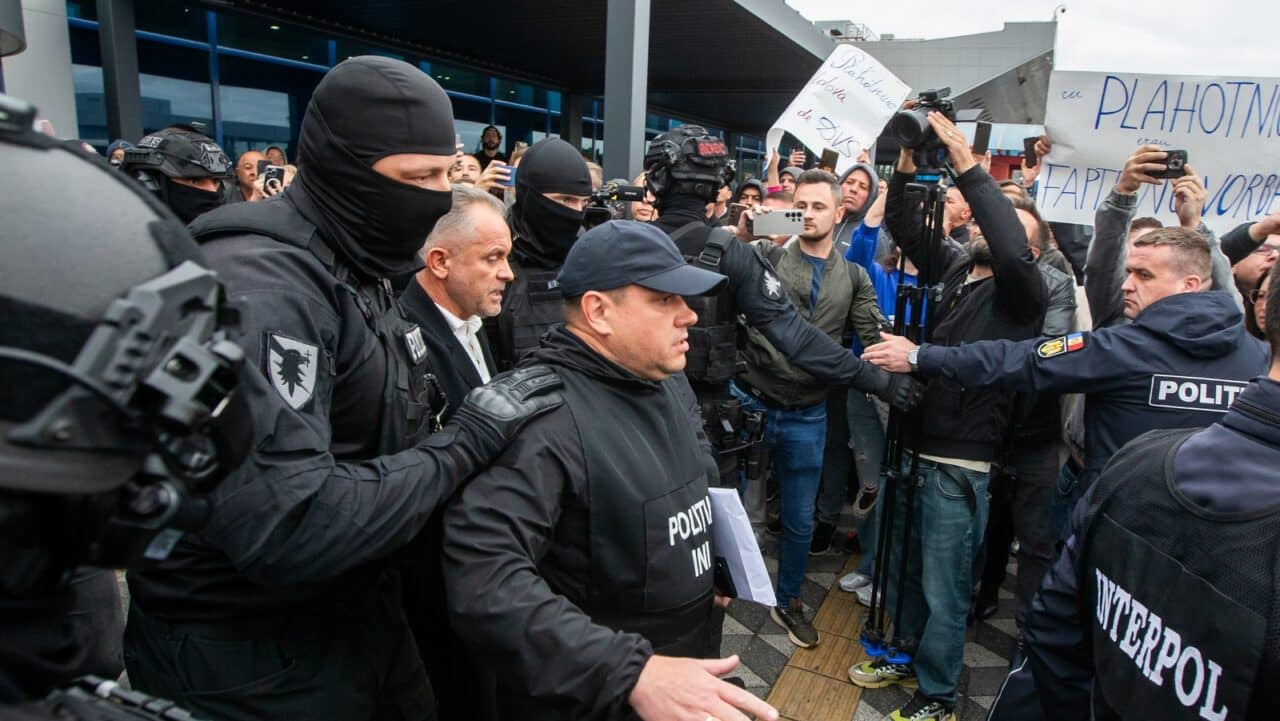
Policemen escort Moldova’s fugitive oligarch Vlad Plahotniuc (C) after his extradition from Greece upon arrival at Chisinau International Airport, Moldova, September 2025. Photo: EPA/DUMITRU DORU.
A court in Chisinau on Wednesday sentenced former Moldovan political leader and oligarch Vladimir Plahotniuc to 19 years in prison on charges including forming and leading a criminal organisation, fraud and money laundering.
Plahotniuc did not appear in court for the verdict. His lawyer had previously called for the case to be reopened and for his client to be acquitted, maintaining that he is innocent.
The court also imposed a ban on Plahotniuc holding any position or exercising any activities related to managing the financial means and material assets of others for a period of five years.
Prosecutors, who had sought a 25-year prison term, said they were dissatisfied with the court’s decision.
“We will analyse the reasoning in the ruling to decide how to challenge it, as we believe the sentence is too lenient given the gravity of the offences,” prosecutor Alexandru Cernei said.
Plahotniuc’s lawyer, Lucian Rugac, announced that he will appeal the verdict.
“We did not expect any other verdict as the entire trial unfolded with serious violations and deviations from fundamental rights and guarantees,” Rugac said.
In 2020, Moldovan prosecutors charged Plahotniuc with involvement in the so-called “theft of the century”, in which huge sums of money disappeared from the country’s banking system between 2014 and 2015.
That scandal saw more than $1 billion (around 850 million euros) siphoned from three Moldovan banks through fraudulent loans and offshore accounts, devastating the country’s economy and badly damaging public trust in state institutions.
Plahotniuc is under investigation in three other cases involving fraudulent privatisation, falsification of public documents and money laundering.
Despite mounting legal cases at home and international sanctions – including US sanctions for corruption and undermining democratic processes – Plahotniuc avoided facing justice for years.
He fled Moldova in June 2019 after the collapse of the Democratic Party-led government, which he was widely seen as controlling from behind the scenes. Since then, he has reportedly moved between the United States, Turkey and the United Arab Emirates, while Moldovan authorities pursued his extradition.
After being extradited from Greece in September last year, Plahotniuc arrived back in Chisinau to face trial in his home country.
Once regarded as the de facto ruler of Moldova, Plahotniuc was accused of running the country as a personal fiefdom, manipulating courts, controlling major media outlets and exercising pervasive influence over political and business life. He dismissed all the allegations as politically motivated.