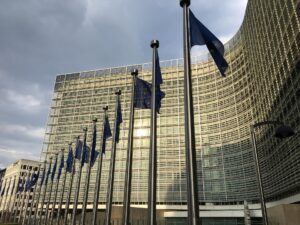

Rose Tchapet Souchtoua, a 39-year old from Cameroon, speaking to journalists in Brussels at the European Parliament, said she was raped and sold as a slave to the highest bidder during her detention in Tunisia.
 Nikolaj Nielsen



Rose Tchapet Souchtoua, a 39-year old woman from Cameroon, says she was raped and sold as a slave to the highest bidder during her detention in Tunisia.
“I was sold as a slave, as an animal, as a good,” she said on Wednesday (22 April).
Speaking to journalists in Brussels at the European Parliament, Souchtoua says she had been chained, raped and beaten.
On top of pervasive racism against black migrants in Mahgreb countries, Souchtoua says many other women jailed in Tunisia and Libya face similar horrors.
“I hope that they will someday be free as I am today, and that they will have the opportunity to come and give accounts of what they’ve experienced,” she said.
Her testimony was among over 30 in a report published earlier this year by an international research group that includes Asgi, an international lawyer association in Italy, and the Swiss-based Border Forensics.
The report identifies the Tunisian National Guard barracks in El Meguissem, alongside a network of Libyan detention facilities in Al Assah, Bir al-Ghanam and Characharah, as key hubs of state-sponsored trafficking.
The five steps of human trafficking
Victims are first captured at various locations across Tunisia before being transported to the Tunisian-Libyan border, where they are further detained.
From there, they are transferred and sold to Libyan state actors and non-state armed groups, while others are held in detention centres until a ransom is paid.
While in Libya, prison guards often used images of female detainees to entice potential Libyan buyers either for sex, slavery or both, it says. Men were sold for labour.
They estimate that around 7,400 people were trafficked over nearly two years, a figure it says is likely an undercount.
From El Meguissem, the researchers identified 59 mass expulsions alone where people are sold to the Al Assah detention complex in Libya.
Indirectly funded by EU
Asgi says a significant part of the infrastructure used for state-sponsored trafficking indirectly benefits from funds made available by the European Union and Italy.
An earlier report that also collected testimonies by same researchers drew similar conclusions amid demands that the European Commission create a humanitarian-legal corridor for witnesses of state-sanctioned trafficking.
But the commission refused, noting instead that it was monitoring the human rights situation in both Libya and Tunisia.
“What is perhaps most shocking is that the Tunisian state, funded by the EU and member states, plays an active role in it,” said laria Salis, an Italian MEP with the Left.
Salis, along with Leoluca Orlando from the Greens and Cecilia Strada from the Socialists and Democrats (S&D), are piling on pressure to stop EU funds from going to Libya and Tunisia.