
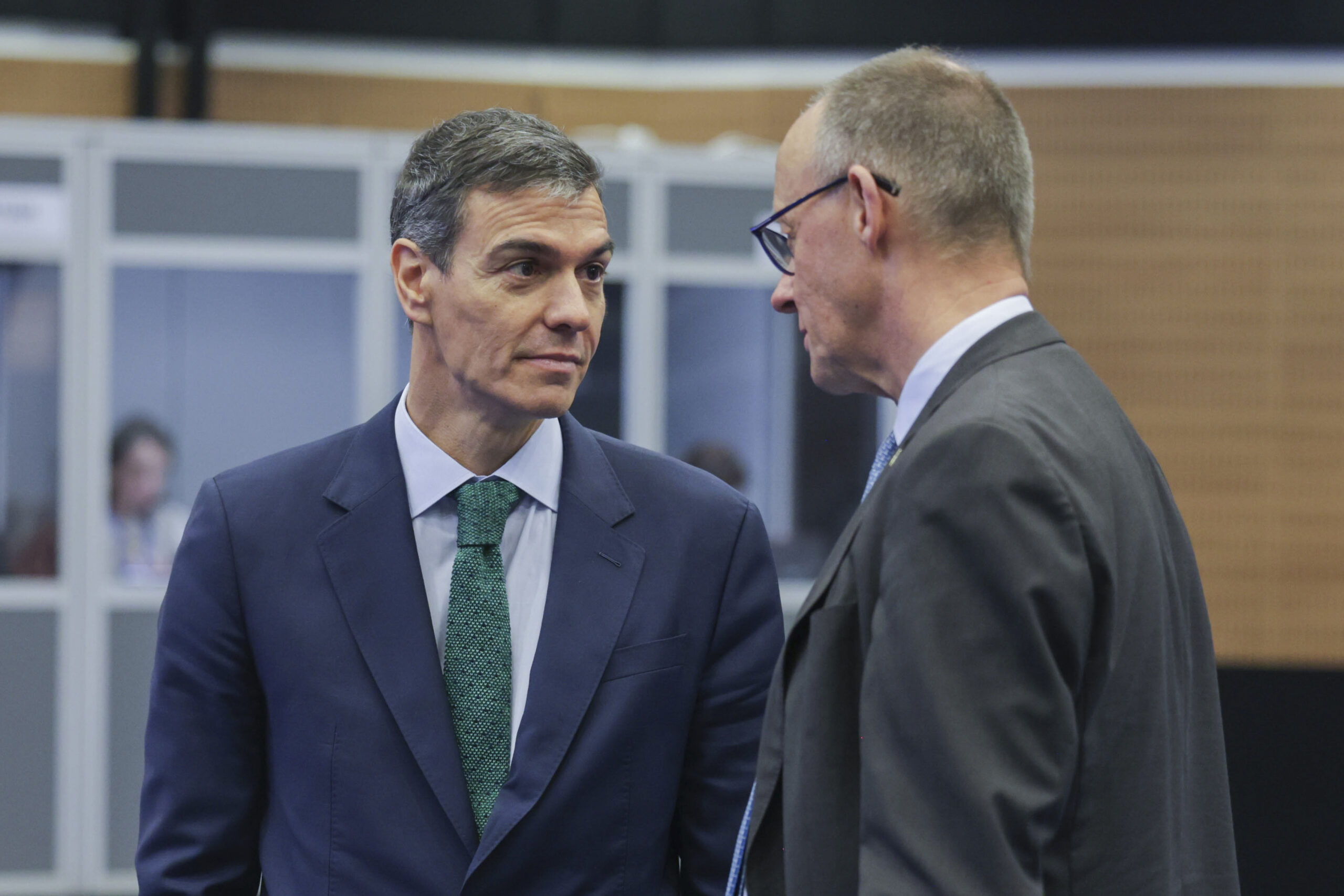
“We don’t discuss internal issues of Nato”, said the EU’s Costa in Cyprus on US threat to Spain, as most EU leaders also ignored Trump ‘squeaky toy’ Pentagon memo.
 Andrew Rettman



US threats to punish Nato allies over Iran spoilt EU celebration on Ukraine funding at an informal summit in Cyprus on Friday (25 April).
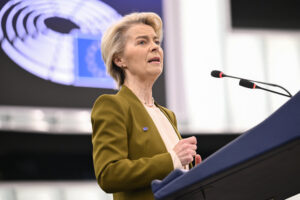
European Commission president Ursula von der Leyen and Cypriot president Nikos Christodoulides declined to answer a press question on the issue at a post-summit press conference.
EU Council chairman António Costa said: “We [the EU] are an international institution. We cooperate with Nato, but we don’t discuss the internal issues of Nato”.
But Dutch prime minister Rob Jetten confirmed on Friday that Trump: “Has a new opinion and he thinks that direct allies should be tackled, including Spain”.
On Spain’s ‘suspension’ from Nato, Jetten said: “I don’t think that’s an official policy of the American government … And let me be clear, I stand by all European countries. Spain is just a full member of Nato. And that remains the case”.
The Pentagon had proposed suspending Spain’s Nato membership and questioned the UK’s sovereignty over the Falkland Islands, in revenge for their refusal to help Trump wage war on Iran, as detailed in a memo leaked to the Reuters news agency on Friday.
A Nato official told the BBC the same day that Nato treaty “does not [legally] foresee any provision for suspension of Nato membership, or expulsion”.
A German government spokesman told press in Berlin: “Spain is a member of Nato. And I see no reason why that should change”.
The UK said Falklands sovereignty was “not in question”.
The Pentagon memo was the latest in a litany of Trump administration attacks on the Western alliance, including a threat to annex Greenland from Denmark and to quit the 80-year-old pact.
And even Polish prime minister Donald Tusk, an Atlanticist, questioned Trump’s “loyalty” to the West, in an interview with the FT newspaper on Friday.
But for their parts, German chancellor Friedrich Merz and Italian prime minister Giorgia Meloni also ducked Nato questions at the Cyprus summit.
“We must work to strengthen Nato’s European pillar … which must clearly complement the American one,” said Meloni.
Kurt Volker, a US envoy to Nato in 2008 and 2009, had counselled EU leaders not to react to Trump provocations.
“You might think that this [the Iran war] is a huge folly and going to have terrible consequences, but you don’t have to say it,” Volker told the Politico website on Friday.
“By saying it, you alienate Donald Trump and you run the risk that he will then link your unhappiness with his policies to his unhappiness for some of your policies”, Volker said, which risked “fragmenting a transatlantic relationship that is still valuable to both of us. So I don’t think that’s a wise way to handle the president”.
And Czech prime minister Andrej Babiš, like Costa, shut down press questions in Cyprus, even on the tangential issue of EU mutual defence.
“No, we didn’t talk about that. Thank you,” said Babiš, who is a Trump-friendly Atlanticist and populist.
The leaked Pentagon memo muted EU celebrations in Cyprus, after Europe unblocked €90bn in Ukraine funding and its 20th round of Russia sanctions, at an event which was attended by Ukrainian president Volodomyr Zelensky.
Christodoulides, Costa, and von der Leyen still talked this up to media on Friday, as well as EU plans to detail protocols on the Article 42.7 mutual defence clause in their treaty.
They also discussed Ukraine accession, energy security in the context of the Iran war, and flexibility in the EU’s next long-term budget.
But going back to the elephant in the room, Ruth Deyermond, a lecturer, in war studies at King’s College London, said on social media: “Either this [Pentagon memo] is just a squeaky toy for Trump to play with, but which is never intended to go anywhere, or a worrying number of people in the [US] administration *really* don’t understand what Nato is or how it works”.