
The war waged by the United States and Israel against Iran is exposing a growing problem. What once looked like a coherent far-right political alignment is increasingly strained by the realities of governing in a volatile global economy. Ideological affinity is one thing, but national interest is quite the other.
 Catherine De Vries



The far-right alliance that rallied around Donald Trump is starting to crack.
War, rising costs and domestic pressures are pulling Europe’s populist right in different directions.
The war waged by the United States and Israel against Iran is exposing a growing problem. What once looked like a coherent political alignment is increasingly strained by the realities of governing in a volatile global economy. Ideological affinity is one thing, but national interest is quite the other.
The electoral defeat of Hungary’s Viktor Orbán by opposition leader Péter Magyar adds another layer to this shift. This is more than a domestic political change.
For years, Orbán embodied a confrontational far-right strategy in Europe that relied on vetoes and institutional obstruction to weaken European cooperation from within.
At the same time, the Orbán government funded and cultivated a broader network of like-minded actors in the US and Europe through conferences and think-tanks based in Budapest.
To understand this shift, it helps to look at how quickly the political context has changed.
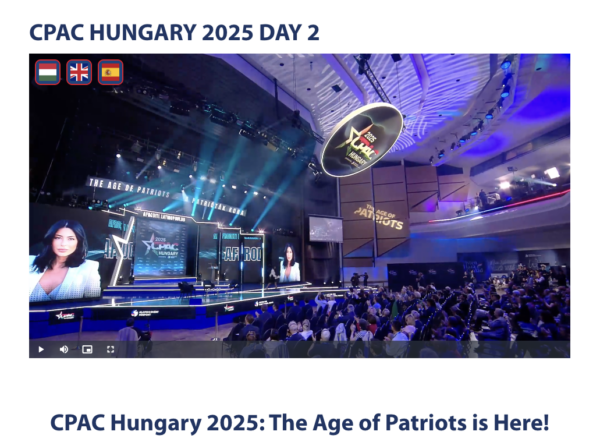
As recently as last year, gatherings such as the Conservative Political Action Conference (CPAC) in Hungary and Poland showcased a confident and seemingly united European far right, reinforced by the presence of senior figures from Donald Trump’s circle.
Today, that sense of alignment is under strain. Endorsements that once signalled political closeness, such as the endorsement of Orbán by US vice-president JD Vance, are increasingly becoming a liability.
United in grievance only
That earlier sense of unity rested on a shared worldview: national sovereignty first, migration as a threat, and scepticism towards international rules.
In that sense, there is a form of ‘Far-Right International’: a loose cooperation through which parties reinforce each other ideologically and occasionally coordinate strategically.
But this cooperation has always contained an inherent tension: what happens when one country’s ‘nation first’ politics collides with another’s?
The war around Iran has brought this tension into sharp focus. As energy prices surge and European governments intervene to shield their economies, political priorities are shifting away from ideological alignment towards domestic necessity.
Italy provides a clear example.
Meloni breaks ranks
Giorgia Meloni long positioned herself as a close ally of Trump. But as the political and economic fallout of the Iran war became more visible in Italy, her position shifted.
She blocked US access to Italian military bases and suspended the automatic renewal of Italy’s defence agreement with Israel.
In doing so, she prioritised domestic interests over ideological loyalty.
A similar shift can be seen in Germany.
The far-right Alternative for Germany (AfD), which had previously aligned itself with Trump’s agenda, is now taking a more cautious stance.
The Iran war has little support among its voters, particularly as economic pressures mount. What had been presented as ideological alignment is increasingly viewed as a political liability.
Even in the UK, criticism is emerging.
Nigel Farage, a long-time admirer of Trump, has described his rhetoric on Iran as excessive. Earlier tensions, such as Trump’s suggestion of annexing Greenland, had already unsettled European allies, highlighting a transactional approach to foreign policy that treats partners as bargaining chips.
These developments are not isolated. They point to a broader pattern: far-right parties may be internationally connected, but they operate from a fundamentally national perspective.
As long as the adversary lies outside national borders, “Brussels”, “migrants” or “global elites”, this tension remains manageable. But when national interests come into direct conflict, the limits of this logic become clear.
This does not mean the far right is losing influence. It remains a powerful force across Europe, with strong prospects in upcoming elections in Germany and France.
What is changing is not its presence, but its method. The Iran war exposes a core contradiction: movements built on national self-interest struggle to sustain stable alliances.
Without Washington, they’re left with Brussels
As alignment with Washington falters, far-right parties in Europe face a strategic choice. Rather than confronting the European Union head-on, they might increasingly engage with it as an instrument of national policy.
When Washington pulls in a different direction, Europe becomes a fallback.
What once appeared as the strongest reason to oppose European integration may, paradoxically, push parts of the far right closer to it, but not out of conviction, out of necessity.
This shift marks not an end, but a transition.
The question is whether far-right parties will continue to pursue a model of competing national interests, or instead consolidate a more pragmatic strategy of working within European structures to advance their goals.
For the EU, this is hardly a moment for complacency.
Leaders such as Robert Fico and Andrej Babiš remain influential, while recent elections in Bulgaria underline the continued appeal of openly pro-Russian positions.
The outcome of this shift is uncertain, but the friction between national interests and ideological alignment is likely to become a defining feature of European politics.