Global military expenditure hit a record high last year, after rising for more than a decade. Poland leads the way in the eastern flank of Nato, despite a steep budget deficit.
 Tomáš Hrivňák



This story is a part of the weekly newsletter about economy, defence, and tech in the eastern flank of Nato, How we cee it.
Global military expenditure hit a record high last year, after rising for more than a decade. Data released by the Stockholm International Peace Research Institute (SIPRI) reveal that the world military spending grew by 2.9 percent, surpassing €2.4trn in value.
This is despite the US cutting virtually all military aid to Ukraine.
Total military expenditure in Europe reached more than €738bn in 2025, up 14 percent from 2024 and again a record high. Over the decade from 2016 to 2025, spending across the continent doubled.
The increase reflects growing geopolitical instability, driven primarily by the Russia–Ukraine war and mounting uncertainty over US security guarantees for European members of Nato.
According to SIPRI, 22 of the 30 European Nato member states allocated two percent or more of their economic output to military expenditure in 2025, the target agreed by the alliance in 2014.
Only two exceeded 3.5 percent. Poland had the highest military budget of any Nato member, at 4.5 percent of GDP. Latvia was second, at 3.6 percent.
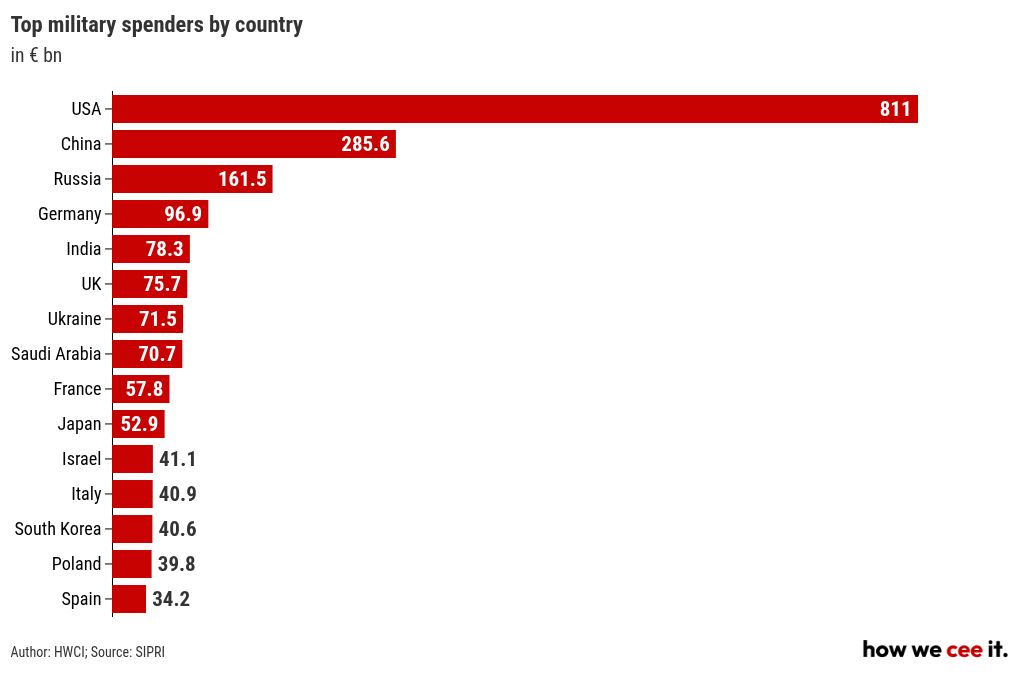
Globally, 15 countries account for 80 percent of all military spending, two of them are from central and eastern Europe: Ukraine and Poland.
Ukraine increased its military spending 16-fold between 2016 and 2025 — for obvious reasons, having to keep fighting off Russian aggression since 2014.
During the full-scale war, spending has only accelerated, rising a further fifth in 2025 to about €72bn, equivalent to 40 percent of GDP and 63 percent of all government spending.
Despite the absence of new US aid commitments, Ukraine received €44.6bn from its partners to support its state budget in 2025 — the highest amount since the war began, and 11 percent more than in 2024. This is the biggest military budget burden of any country in the world.
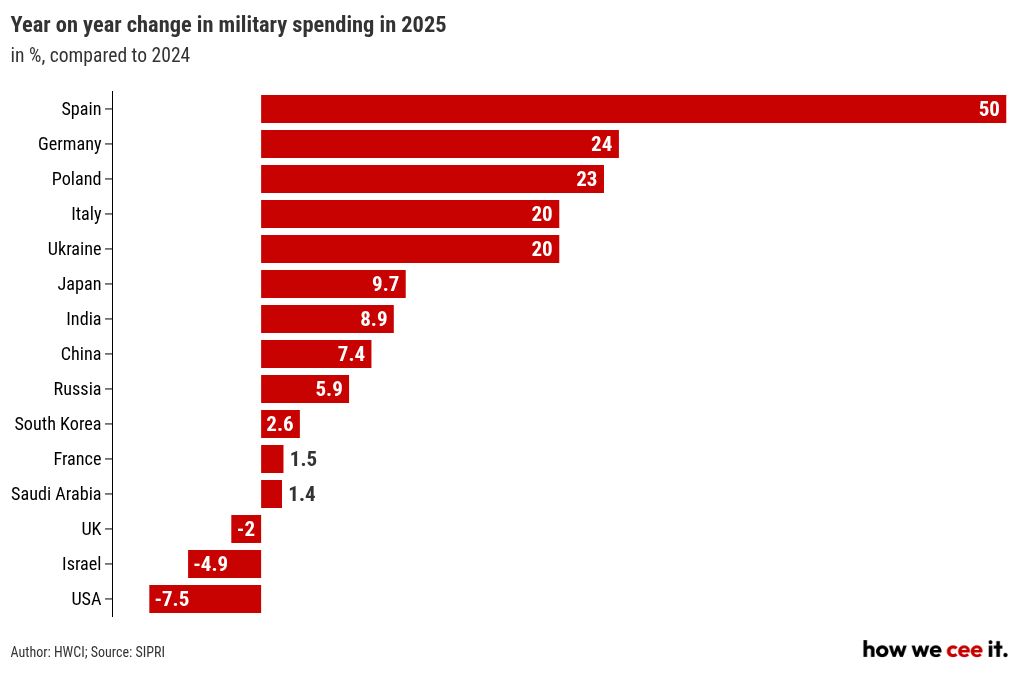
The second-largest CEE spender in the top 15 is Poland, which has spent years building one of Europe’s biggest armies. Its military expenditure reached €40bn in 2025, up 23 percent year on year and more than three fold since 2016.
But the spending spree carries a cost.
Poland’s budget deficit has ballooned to 7.3 percent, more than double the EU’s three-percent guideline. Even so, Polish finance minister Andrzej Domański told Bloomberg that defence spending is, and will remain, Warsaw’s top priority.
He and his counterparts from the three Baltic states agreed in Vilnius on Friday (24 May) to cooperate more closely on military funding, including lobbying the EU for greater support and seeking low-cost loans from outside the bloc.
Poland is also in talks over a joint financing and procurement initiative led by the Netherlands, the UK and Finland, known as the Multilateral Defence Mechanism.
Poland is already the largest beneficiary of the EU’s €150bn loans-for-weapons programme, known as Security Action for Europe (SAFE). Its defence drive has been accompanied by continued growth in social spending, with the government relying on robust economic expansion to keep the budget gap in check.
Czech Republic struggles to meet basic Nato-spending criteria
Beyond the top 15, Romania, Finland and the Czech Republic all rank within SIPRI’s top 40 military spenders by expenditure.
Romania allocated €8.3bn to defence last year, up roughly 140 percent since 2016. With war just beyond its borders, it shows no sign of slowing.
Romanian lawmakers approved on Tuesday defence contracts worth €8.3bn to be funded under the EU’s new SAFE rearmament initiative. The country can access €16.6bn from SAFE between now and 2030.