



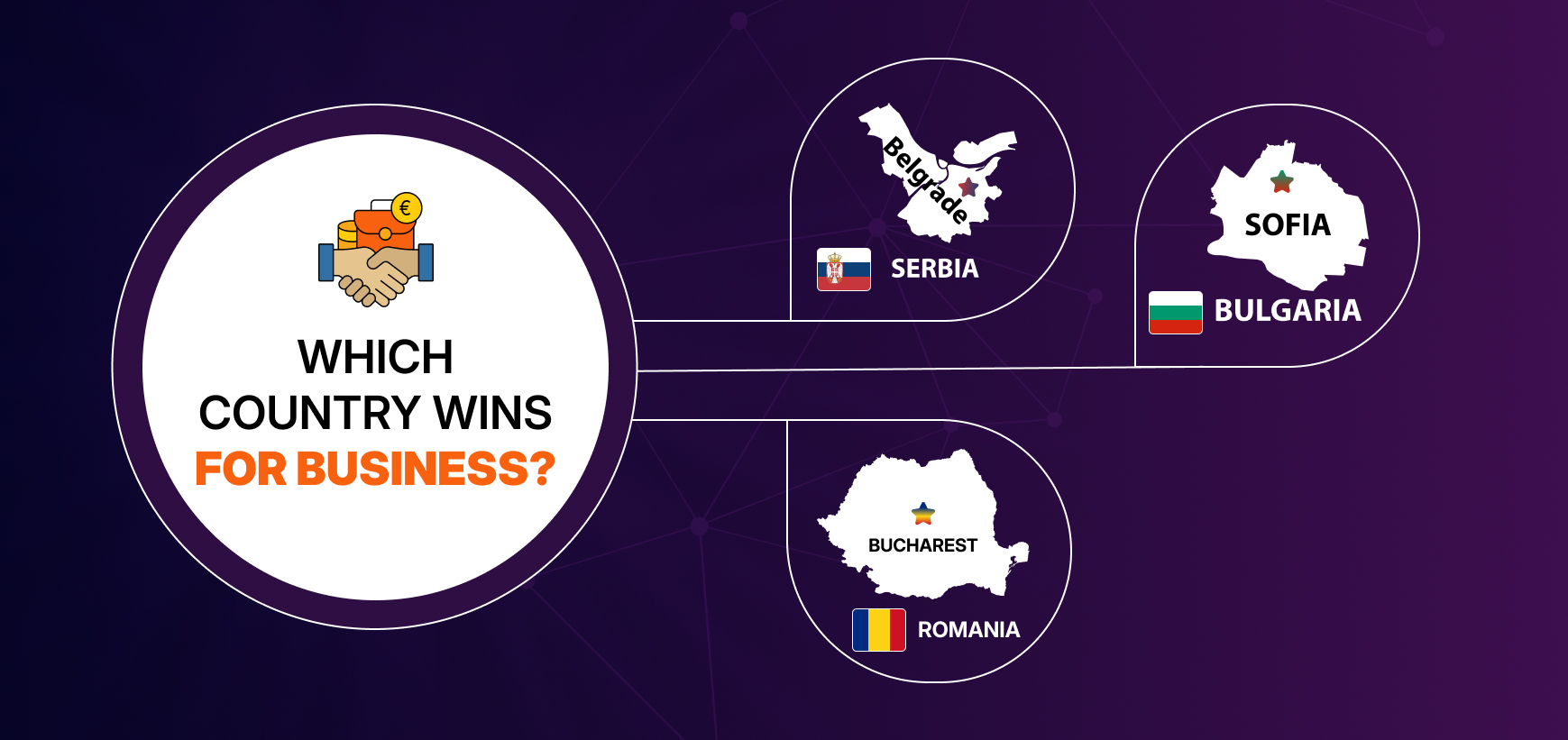
If you are thinking about moving your business to Southeastern Europe, you have probably hit a wall. There are three names that keep popping up: Serbia, Bulgaria, and Romania. They are the “Big Three” of the region. They all offer low costs, smart people, and great locations. But they are not the same. Choosing the wrong one can cost you time, money, and a lot of headaches.
Whether you are running a tech startup, a manufacturing plant, or an e-commerce store, the Serbia vs Bulgaria vs Romania business debate is real. Each country has its own personality, its own rules, and its own perks.
In this Balkan business comparison, we are going to strip away the fluff. We will look at the taxes, the ease of doing business in the Balkans, and the talent pool. By the end, you should have a clear idea of which one is the best country to do business in the Balkans for your specific needs, including business in Bulgaria.
The Big Picture: EU vs. Non-EU
Before we dive into the details, let’s look at the biggest difference.
- Romania and Bulgaria: They are in the European Union (EU). This gives you full access to the EU single market. It means easier trade with countries like Germany and France and generally more stable legal systems.
- Serbia: It is not in the EU (yet). It is a candidate country. However, it is very independent and has signed free-trade agreements with the EU and Russia. It is agile and often offers better tax breaks to compete with its neighbors.
Romania: The Market Giant
Romania is the heavyweight champion of the region. It has the largest population (around 19 million people) and the biggest economy. If you want to sell things to locals, Romania is the place to be.
- The Tax Deal: Corporate income tax is a flat 16%. It is not the lowest in the region, but it is still much lower than Western Europe.
- The Talent: This is Romania’s superpower. The country has a massive number of IT engineers. Cities like Cluj-Napoca and Bucharest are famous tech hubs.
The Pros:
- Huge local market.
- Very high level of English proficiency.
- Stable legal system because of EU membership.
The Cons:
- Bureaucracy can be slow. You might wait a while for permits.
- Infrastructure is improving but still lags in some rural areas.
Who is it for?
If you are in tech, software, or e-commerce and want access to a large, skilled workforce, Romania is a top pick.
Bulgaria: The EU Tax Haven
Bulgaria is often called the most stable of the three. It has been in the EU since 2007 and uses the lev (which is pegged to the Euro). It is predictable and safe.
- The Tax Deal: This is the main attraction. Bulgaria has the lowest standard corporate tax rate in the entire EU at just 10%.
- The Talent: Bulgarians are well-educated, especially in mathematics and engineering. However, many skilled workers have moved abroad, so there is a bit of a labor shortage in some sectors.
The Pros:
- Incredibly low taxes (10%).
- Very safe and stable.
- EU membership makes exporting easy.
The Cons:
- The population is shrinking and aging.
- Corruption and slow courts can still be an issue.
Who is it for?
If you want the safety of the EU and the lowest possible tax bill, Bulgaria is the winner. It is great for holding companies or IT businesses that can hire the right talent.
Serbia: The Agile Innovator
Serbia is the wild card. It is not in the EU, which scares some people off. But the government is hungry for investment. They are aggressive about making it easy for foreigners to start companies.
- The Tax Deal: Corporate tax is a flat 15%. Here is the kicker: If you are an IT company or a startup, you might pay 0% corporate tax for up to 10 years, depending on the specific incentives.
- The Talent: Serbians are known for being creative, hard-working, and very tech-savvy. Belgrade is a buzzing hub for startups.
The Pros:
- Aggressive tax incentives (especially for IT).
- Very low cost of living and operating costs.
- The government is very pro-business and fast to react.
The Cons:
- Not in the EU (yet). This adds a layer of customs if you export goods.
- Political stability can feel less certain than in the EU.
- The currency is the Serbian Dinar, which can fluctuate.
Who is it for?
If you are a startup, a freelancer, or in the tech industry, Serbia is amazing. The incentives are too good to ignore.
Head-to-Head Comparison
Let’s put these three side-by-side and see how they really stack up against each other.
1. Cost of Doing Business
Let’s talk about money first. Serbia usually wins here, it’s generally the cheapest option for office space and salaries. Bulgaria isn’t far behind, but you will notice prices are a bit steeper there. Romania is the most expensive of the group. The tech boom in cities like Bucharest and Cluj has pushed wages up pretty fast recently.
2. Ease of Setup
How long does it take to get the lights on? Serbia might actually surprise you, it’s incredibly fast. You can often register a company entirely online in just a day or two. Bulgaria is just as efficient and has gone digital, too. Romania is improving, but you might still run into some red tape that slows you down a bit compared to the other two.
3. Taxation
This is where everyone pays attention. Bulgaria takes the crown for the lowest standard rate at a flat 10%. But don’t count Serbia out; their incentives for specific sectors are crazy good. Tech companies, for example, might pay zero tax for a long time. Romania sits at 16%, which is higher, but you are basically paying that premium to access a massive market.
4. Location & Logistics
Where you sit on the map matters. Romania is your best bet if you need to ship goods all over the EU without hassle. Bulgaria acts as a great bridge to Greece and Turkey while keeping you connected to Western Europe. Serbia sits right in the middle of the Balkans, which is strategic, but since it’s not in the EU, moving goods across borders can take a little longer because of customs checks.
Which one should you pick?
Ultimately, picking the right spot comes down to what matters most to you and your business.
Choose Romania if:
- You need to hire a lot of skilled workers (especially programmers).
- You want a big local market to sell to.
- You are risk-averse and want the stability of the EU.
Choose Bulgaria if:
- Your main goal is to minimize taxes.
- You want to be in the EU but don’t need a huge local market.
- You want a stable currency pegged to the Euro.
Conclusion
There is no single “winner” in the Serbia vs. Bulgaria vs. Romania business battle. All three are excellent choices, but they excel in different areas.
If you want stability and the lowest tax rate in the EU, go to Bulgaria. If you need a massive market and top-tier tech talent, go to Romania. If you want the lowest operating costs and amazing incentives for startups, go to Serbia.
Doing business in the Balkans is about finding the right fit for your company’s DNA. Do your math, visit the cities, and talk to local accountants. Once you make your choice, you will find that the Balkans offer an opportunity for growth that is hard to match anywhere else in Europe right now, especially for business in Bulgaria.
Frequently Asked Questions
1. Which country has the lowest taxes for business?
Bulgaria has the lowest standard rate at 10%. However, Serbia often wins for specific sectors like IT because they offer 0% tax for long periods.
2. Is it easier to set up a company in Serbia or Bulgaria?
Both are relatively easy compared to Western Europe. You can often do it online in a few days in both countries. Bulgaria might feel slightly more familiar if you are used to EU regulations.
3. Can I hire remote workers easily in these countries?
Yes, all three countries have a strong culture of remote work, especially in the tech sector. Romania is famous for its remote developers. You will need to check local labor laws or use an employer-of-record service to handle payroll and taxes.